
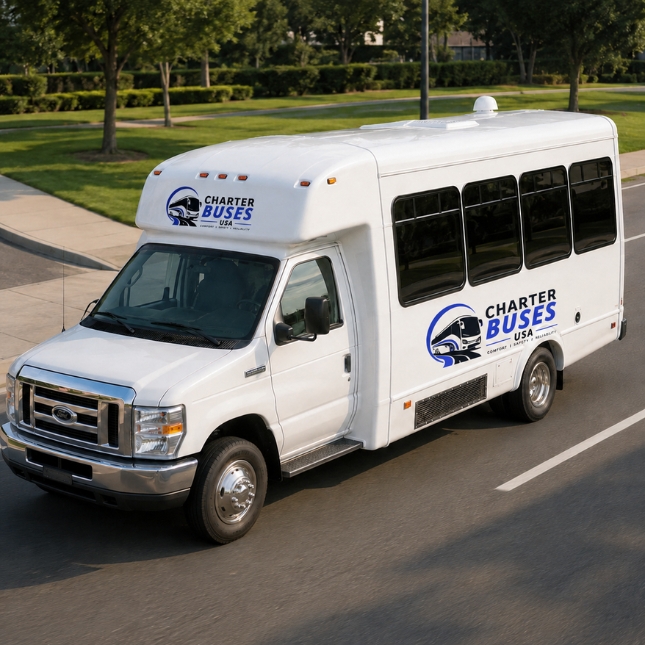
One-Time Shuttle Transfer
Reserve transportation for a defined pickup and destination, such as an airport-to-hotel transfer, office event or private group arrival.
| HOURLY PRICE | $110 – $250 |
|---|---|
| DAILY PRICE | $1,100 – $2,000 |
| Passenger Capacity | 20–40 Passengers |
| Best For | Airport Transfers, Hotel Shuttles, Corporate Transportation, Employee Shuttle Services, Convention Transportation, Campus Transportation, Hospital Shuttles, Wedding Guest Transportation, Church Groups, Private Events |
| Amenities | Air Conditioning, Heating, Reclining Seats (Select Models), Wi-Fi (Available), USB Charging Ports, Power Outlets, PA System, Reading Lights, Individual Air Vents, Tinted Windows, Overhead Storage, Cup Holders |
| Driver | Professional CDL-Licensed Driver Included |
| Seating | Comfortable Forward-Facing Seats with Ample Legroom |
| Luggage Capacity | Rear Luggage Storage with Overhead Compartments (Select Models) |
| Interior | Modern Cabin with Comfortable Seating and Wide Center Aisle |
| Ideal Group Size | Small to Mid-Sized Groups, Corporate Teams, Hotel Guests, Airport Travelers, Event Attendees |
Licensed & Insured
Professional Drivers
Fast Free Quotes
Nationwide Service
24/7 Reservation Support
Modern Fleet
Dedicated Trip Specialists
Charter Buses USA provides private shuttle bus rentals for organizations, event planners and travel groups that need dependable transportation between two or more locations.
Unlike transportation arranged for a single journey, a shuttle service can operate repeatedly throughout a defined period. The vehicle may circulate between an airport and hotel, connect remote parking areas with a venue, transport employees between transit stations and offices, or move convention attendees among several event locations.
Each shuttle bus rental is organized around how passengers need to move. That includes the number of riders expected at each pickup point, the distance between stops, departure frequency, service hours, loading conditions and the amount of time required to complete each route cycle.
Charter Buses USA can coordinate one-time shuttle transportation, continuous event loops, recurring employee routes and multi-day transportation programs. Your service may use one bus or several vehicles depending on passenger demand, route timing and the number of passengers who must be moved within each operating window.
Our reservation team reviews the full transportation need before helping recommend a vehicle and schedule. A short hotel transfer for twenty passengers has different requirements from a convention shuttle moving hundreds of attendees throughout the day. Building the service around real passenger flow helps create a more practical route than simply reserving a bus by seat count.
Reserve transportation for a defined pickup and destination, such as an airport-to-hotel transfer, office event or private group arrival.
Operate repeated loops between hotels, parking areas, entrances, conference centers and event venues during a scheduled service window.
Arrange daily, weekly or project-based transportation connecting employees with offices, job sites, transit hubs and remote parking facilities.
Coordinate consistent transportation across conferences, conventions, corporate programs, tournaments and events lasting several days.
Share your passenger volume, operating hours, pickup points, destination and preferred departure frequency for a personalized transportation plan.
A shuttle bus rental is private group transportation arranged around a defined route, operating period and passenger schedule. The service may run once, repeat throughout the day or operate on a recurring basis.
A traditional charter bus reservation often focuses on transporting one group from a pickup location to a destination and returning later. Shuttle transportation may involve shorter distances, repeated departures, rotating passenger groups or several nearby stops.
For example, an event organizer may need buses to circulate between three hotels, a parking facility and a conference venue for ten hours. Passengers may board at different times, and each route cycle must be timed around attendance patterns. That service requires more than selecting a bus with enough seats. The planner must consider passenger volume, loading time, traffic, stop sequence and the number of vehicles needed to maintain the preferred frequency.
Employee shuttles create another type of operating pattern. Some businesses need transportation during morning and evening commuting periods. Others require continuous movement between offices, warehouses, parking lots or project sites. The route may operate daily, seasonally or only during a temporary construction or relocation period.
Charter Buses USA coordinates shuttle transportation around these practical details. We review the service window, estimated riders, stop locations, vehicle capacity, luggage or equipment requirements and the amount of time needed to complete each trip cycle.
This route-based planning helps determine whether one vehicle can complete the service effectively or whether several buses and staggered schedules are needed.
A vehicle follows the same planned route between two or more stops. This format is common for employee transportation, campuses, hotels, parking facilities and recurring business travel.
The bus departs at scheduled times rather than operating continuously. This can work for airport groups, weddings, conferences, dinners and private events with known passenger departure windows.
One or more buses repeat the same route throughout a defined period. Continuous loops are often used for conventions, festivals, parking transportation, large events and venues with several passenger pickup points.
Share your stops, service hours, estimated passenger demand and preferred departure frequency for route-planning support.
A shuttle bus is often the right choice when the transportation challenge is not only moving people once, but moving them repeatedly, predictably and between locations that must stay connected throughout the day.
If your group needs repeated departures, several pickup points, staggered arrivals or continuous circulation, a dedicated shuttle route may be more practical than separate cars or one-time transfers.
Choose a shuttle when several travelers need to move between an airport, hotel, conference center, cruise terminal or corporate location on a shared schedule.
The route can be planned around one arrival group or several scheduled pickup windows, with luggage requirements reviewed before vehicle selection.
Businesses can use recurring shuttles to connect employees with offices, warehouses, transit stations, remote parking lots, temporary job sites or multiple company locations.
Routes may operate during morning and evening peaks, across shift changes or continuously during a defined workday.
Conventions often require transportation among hotels, meeting venues, restaurants, evening events and off-site functions.
Shuttle schedules can be built around registration periods, session start times, attendee volume and different operating windows across several event days.
A shuttle bus helps connect overflow parking areas with stadiums, festivals, corporate campuses, hospitals, event venues and construction sites.
Continuous loops can reduce walking distance and create a clearer passenger flow before and after peak arrival times.
Hotels and event organizers may use private shuttles to move guests between properties, airports, venues, restaurants and local attractions.
Service may follow fixed departure times or a repeated route during periods of highest guest demand.
Wedding shuttles are useful when guests are staying at more than one hotel, parking is limited or the ceremony and reception are held at different locations.
Multiple departure windows can help move guests before the ceremony and provide organized returns at the end of the celebration.
Colleges, training institutions and large campuses may need transportation between residence halls, parking lots, classrooms, athletic facilities and event locations.
Routes can support daily mobility, special programs, orientation events, campus tours or temporary construction changes.
Medical facilities can use shuttles to connect employee parking, hospital entrances, clinics, research buildings and nearby transit stations.
Vehicle accessibility, boarding time and service frequency should be reviewed carefully when planning healthcare routes.
Construction projects may require transportation from remote parking areas, hotels or designated meeting points to active work zones.
Routes may be scheduled around crew shifts, site access restrictions and limited parking availability.
Teams, coaches, officials and support staff may need repeated transportation between hotels, fields, arenas, training facilities and dining locations.
Equipment storage and the number of route cycles should be considered before selecting the vehicle plan.
Cruise groups can use shuttle transportation between airports, hotels, parking areas and port terminals.
Luggage volume, terminal access rules and boarding windows should be included in the route plan.
Private groups may reserve a shuttle for celebrations, restaurant routes, nightlife transportation, tours, family reunions and entertainment events.
A planned route keeps the group together and reduces the need for several drivers, parking arrangements and separate return rides.
A standard charter trip may be enough when one group boards at one location, travels to one destination and returns later. A shuttle bus becomes more useful when the transportation pattern involves repeated movement, several passenger groups or multiple nearby stops.
Consider passenger timing first. If everyone departs together, one scheduled charter may be sufficient. If guests, employees or attendees arrive over several hours, a timed or continuous shuttle can create a smoother operating plan.
Passenger volume also matters. A single vehicle may handle a small loop effectively, but a large event could require several buses operating on staggered cycles. The route length, boarding time and turnaround period all influence how many passengers can be moved within each hour.
The physical environment should also be reviewed. Narrow loading areas, restricted venue entrances, airport rules, remote parking lots and campus traffic patterns may affect vehicle size and stop placement.
Charter Buses USA evaluates these details together so the transportation plan is based on actual passenger flow rather than a generic vehicle recommendation.
The correct shuttle size depends on how many passengers must move during each departure window, how much luggage or equipment they carry, how quickly the route must repeat and whether one or several vehicles will operate.
A compact shuttle may be suitable for executive teams, airport groups, hotel transfers, private events and smaller employee routes where passengers travel with limited luggage.
A 24-passenger shuttle can provide a useful balance between passenger capacity and urban maneuverability for wedding routes, convention transfers and workplace transportation.
A 30-passenger shuttle is commonly considered for larger corporate teams, conferences, universities, sports groups, employee routes and event circulation.
A larger shuttle may support conferences, remote parking programs, workforce transportation and high-volume routes where more passengers must be moved during each cycle.
| Planning Factor | 20-Passenger Shuttle | 24-Passenger Shuttle | 30-Passenger Shuttle | 40-Passenger Shuttle |
|---|---|---|---|---|
| Typical use | Small airport, hotel and corporate groups | Weddings, meetings and moderate event service | Employee, conference and campus routes | Large events, parking and workforce programs |
| Route environment | Compact urban streets and smaller loading areas | City routes with several planned stops | Repeated shuttle cycles and larger venues | High-volume routes with organized loading zones |
| Luggage planning | Best when baggage is light or limited | Moderate luggage may require vehicle review | Storage varies and should be confirmed | Passenger capacity may still compete with storage |
| Service pattern | One-time transfers or shorter loops | Timed departures and hotel shuttles | Recurring or continuous service | High-frequency or high-demand operations |
| Best decision basis | Compact service and limited passenger demand | Balanced capacity and maneuverability | Passenger volume during peak departure windows | Hourly passenger movement and route efficiency |
Choosing the largest available vehicle may appear to be the easiest way to handle passenger demand, but larger capacity does not automatically create a better shuttle service. Vehicle size must work with the route, loading area, trip frequency and passenger arrival pattern.
A larger bus may move more passengers during one departure, but it may also require more loading space, additional boarding time and wider turning access. For a route involving narrow hotel entrances, downtown streets or restricted event areas, two smaller shuttles may provide better circulation and shorter waiting periods.
Passenger demand is rarely distributed evenly. A convention may have a large rush before the first session and lighter demand during the afternoon. An employee route may require several buses during shift changes but only one vehicle between peak periods. Understanding these changes helps avoid assigning the same capacity throughout the entire day when demand does not justify it.
Luggage can also reduce practical capacity. A 30-passenger airport shuttle carrying thirty large suitcases may not provide the same usable passenger space as a shuttle transporting employees with personal bags. The reservation team should know both the rider count and the items traveling with them.
Accessibility needs can influence seating configuration and boarding time. If passengers use mobility devices, request an accessible vehicle early and explain the number of riders requiring accommodations. The route schedule should allow enough time for safe boarding and unloading.
Charter Buses USA considers these factors together before helping recommend a shuttle plan. The objective is to move passengers efficiently and comfortably—not simply to fill every available seat.
Avoid planning every departure around a completely full bus. A small seating margin can support passenger changes and easier boarding.
For continuous routes, compare total hourly passenger demand with the number of riders each vehicle can move per cycle.
Confirm whether the pickup point can safely accommodate the vehicle size and whether buses may wait, stage or return.
Passenger volume may rise and fall throughout the day. Consider staggered vehicles or different service frequencies.
Share your passenger estimates, operating hours, stop locations, luggage needs and preferred departure intervals.
Airport transportation becomes more complex when passengers arrive on different flights, carry luggage, use several terminals or need scheduled transfers to multiple hotels and venues.
A private airport shuttle bus rental gives travel planners a coordinated way to move groups between airports, hotels, convention centers, offices, cruise terminals and event venues. Instead of asking passengers to reserve separate rides, the group can follow one confirmed pickup plan with a professional driver.
Airport shuttle service may be arranged for one arriving flight, several flights within a short period or a larger event with travelers arriving throughout the day. The route can include one terminal pickup, multiple airport collection windows or a continuous schedule between the airport and nearby hotels.
Group organizers should provide flight information when it is available, but the transportation plan should not rely on flight time alone. Passengers need time to leave the aircraft, collect baggage, move through the terminal and reach the designated loading area. International arrivals may require additional time for immigration and customs processing.
Luggage is another major planning factor. Twenty travelers attending a local meeting with small bags create a different space requirement from twenty cruise passengers carrying large suitcases. The vehicle recommendation should account for both the rider count and the expected baggage volume.
Airport rules and loading locations vary. Some terminals provide designated commercial vehicle zones, while others restrict how long a shuttle may wait near the curb. A realistic schedule should account for staging, terminal access and the time needed to load the full group.
Reserve one shuttle for a team, family group, wedding party or tour group arriving together on the same flight.
Create several pickup windows for passengers arriving on different flights without requiring a separate vehicle for every traveler.
Operate scheduled service between the airport and one or more hotels during a convention, wedding or corporate event.
Move cruise passengers between terminals, hotels and ports while accounting for luggage and embarkation schedules.
Start with the scheduled arrival time, but build the pickup plan around when passengers can realistically reach the loading area. Domestic travelers may still need time to walk from the gate, collect checked baggage and locate the meeting point. Larger airports can add significant walking and terminal-transfer time.
When passengers arrive on several flights, group them into practical pickup windows. Sending one shuttle for every flight may create unnecessary cost, while making early travelers wait too long for later arrivals can reduce the quality of the experience. The best schedule balances reasonable waiting time with vehicle efficiency.
Departure planning should work backward from the recommended airport arrival time. Consider hotel pickup, traffic, terminal access, baggage check, security screening and the airline's boarding schedule. Large groups usually need more time to load and unload than individual travelers.
For conferences and weddings, airport transportation may be only one part of the complete shuttle program. The same planning process can connect arriving guests with hotels, events and return flights across several days.
Employee transportation works best when routes are planned around shift times, transit connections, parking limitations, workplace access and the number of riders expected during each operating period.
Charter Buses USA coordinates corporate shuttle bus rentals for businesses that need a structured way to move employees, contractors, clients or visiting teams between important locations. Routes can connect offices with train stations, remote parking lots, hotels, warehouses, construction sites, campuses and temporary facilities.
Some companies need transportation only during morning and evening commuting periods. Others require continuous service throughout the day, repeated departures across several shifts or temporary transportation during an office move, parking shortage or large project.
A private employee shuttle can reduce the need for individual parking, simplify travel between company locations and create a more predictable arrival plan for teams working on the same schedule. Employees can board at designated points and travel together instead of arranging separate cars or rideshare pickups.
The most effective program is built around actual rider behavior. That includes where employees live or connect with public transportation, when shifts begin and end, how many people are expected at each stop and how long the route takes during peak traffic.
Charter Buses USA reviews these details before helping plan the vehicle size, number of departures and operating window. The goal is to create a shuttle schedule that supports the workplace rather than forcing employees into a route that does not match their working hours.
Connect employees with nearby rail, subway or bus stations to help bridge the final distance between public transit and the workplace.
Move employees between overflow parking areas and offices, hospitals, factories, campuses or construction sites where nearby parking is limited.
Create scheduled routes between headquarters, satellite offices, training facilities, warehouses and client locations.
Arrange project-based transportation during office moves, construction, seasonal hiring, events or temporary workplace changes.
Remote parking routes can help businesses use available parking areas without requiring every employee to park next to the workplace.
Defined pickup times give teams a shared arrival schedule and reduce dependence on inconsistent individual travel arrangements.
Employees can travel between offices, campuses, training sites and operational facilities under one coordinated route plan.
Vehicle frequency can be increased during shift changes and reduced during lower-demand periods.
Begin by identifying the transportation problem the route must solve. A remote parking shuttle has different goals from a commuter connection or an interoffice route. Define whether the priority is reducing parking demand, supporting shift arrivals, connecting public transportation or moving employees among several facilities.
Next, estimate passenger demand by time and stop. A route may carry sixty employees during the morning rush but only fifteen passengers at midday. Using the same frequency all day may create unnecessary operating time, while too few departures during peak periods can lead to long waits.
Route timing should be tested against real traffic conditions. A trip that takes fifteen minutes outside rush hour may take much longer during morning congestion. Include boarding, unloading and turnaround time when calculating how frequently the shuttle can depart.
Stop placement should be practical and easy to communicate. Employees need clear boarding points that are safe, visible and accessible. Large buses may require designated loading zones, while smaller shuttles may offer more flexibility near offices or transit stations.
Accessibility requirements should be reviewed before the program begins. If employees use mobility devices or require boarding assistance, request an appropriate vehicle and allow sufficient time at each stop.
Once the route is operating, passenger demand may change. Businesses can review ridership, departure times and stop usage to determine whether the schedule should be adjusted. A shuttle program should remain responsive to the workforce it serves rather than staying fixed when employee needs have changed.
Successful event transportation depends on more than adding buses. Routes must connect hotels, parking areas, venues and off-site activities while keeping waiting times practical and departures aligned with the event schedule.
Hotels, convention centers and event venues often operate as separate parts of the same guest experience. Attendees may sleep at one location, register at another, attend meetings across several buildings and join evening activities away from the main venue. A coordinated shuttle program connects these locations under one transportation plan.
Charter Buses USA arranges hotel and event shuttle bus rentals for conferences, conventions, trade shows, festivals, weddings, corporate programs, private gatherings and other occasions where passengers need scheduled transportation throughout the day.
The planning process begins with expected passenger flow. Organizers should estimate how many people will travel from each hotel, which times will create the largest demand and how many minutes a complete route cycle will require. A route that appears short on a map may take longer when boarding time, downtown traffic and venue loading rules are included.
Shuttle frequency should follow the event schedule. Large arrival waves may require several buses before registration or the opening session. Midday service may operate less frequently, while evening departures may need staggered return times for guests leaving at different points.
Hotel stops must also be practical. Large coaches may not fit every driveway or covered entrance. Organizers should identify commercial loading zones, safe boarding areas and whether vehicles can wait at each property. When one hotel cannot support bus access, a nearby meeting point may be required.
Clear passenger communication is essential. Guests should receive the shuttle schedule, pickup location, route name and final departure time before the event begins. A strong transportation plan works best when passengers understand how and where to use it.
Connect one or several hotel properties with airports, convention centers, wedding venues, restaurants and local attractions.
Move attendees, exhibitors, staff and speakers among hotels, meeting facilities, registration areas and evening events.
Operate loops between remote parking areas, venue entrances, overflow lots and designated passenger loading zones.
Arrange separate schedules for executives, performers, speakers, sponsors and guests requiring dedicated transfers.
Service frequency can change throughout the day to reflect registration, session timing and evening activities.
The answer depends on how many passengers must move during the busiest period, how long the route takes and how often guests should be able to depart. A total attendance number alone is not enough to determine the fleet.
An event with 500 attendees may not need transportation for all 500 people at the same time. Some guests may stay within walking distance, use personal vehicles or arrive outside the main pickup period. Organizers should estimate likely shuttle demand for each hotel and time window.
Route-cycle time is equally important. A bus that seats thirty passengers and completes a loop every twenty minutes can move more people per hour than the same bus on a forty-five-minute route. Boarding delays and traffic can reduce the number of cycles completed during peak demand.
Several smaller buses may sometimes work better than one large vehicle. Smaller shuttles can depart more frequently, serve different hotels and navigate restricted loading areas. Larger buses may be more efficient when high passenger volumes originate from a single location with sufficient staging space.
Charter Buses USA reviews passenger estimates, route times, loading conditions and event timing before helping determine the shuttle plan. The goal is to reduce unnecessary waiting without assigning more capacity than the event requires.
Educational and community groups often need transportation that serves several buildings, parking areas, event locations and passenger schedules rather than one simple pickup and drop-off.
Charter Buses USA coordinates shuttle bus rentals for universities, schools, churches, youth programs and community organizations that need private transportation with a professional driver. Service can be planned for one event, recurring campus routes, multi-day programs or transportation operating at scheduled intervals.
A university may need continuous service between residence halls, commuter parking, classrooms, athletic facilities and event venues. A church may need several pickup locations for a retreat, conference or volunteer event. A school or youth program may need organized transportation for students, chaperones, staff members and equipment.
These groups often have different travel patterns from a standard private event. Passengers may board at several locations, travel at different times or require repeated movement throughout the day. The route must account for attendance, class schedules, worship times, program sessions, parking capacity and loading access.
Vehicle selection should also consider passenger age, luggage, educational materials, instruments, athletic gear and mobility needs. A vehicle with enough seats may still be unsuitable if the group carries substantial equipment or requires a specific accessible configuration.
Charter Buses USA reviews the complete transportation plan before helping recommend a shuttle size and operating schedule. This planning-first approach supports more organized boarding, clearer passenger communication and a route that reflects how the group will actually travel.
Colleges and universities may use shuttle buses to connect commuter parking, residence halls, classrooms, laboratories, athletic centers, hospitals and satellite campuses.
Short-term transportation can also support orientation, graduation, campus tours, conferences, alumni events, recruitment programs and construction-related detours.
Route frequency should reflect class transitions, event schedules and peak arrival periods rather than remaining identical throughout the day.
Church shuttle rentals can support worship services, retreats, conferences, volunteer programs, youth activities, choir travel, community events and transportation for senior members.
Routes may connect neighborhoods, hotels, overflow parking, airports, worship facilities and retreat locations under one organized schedule.
Groups should share accessibility needs, luggage, instruments and mobility considerations before the vehicle is selected.
Schools, camps, academies and youth organizations can arrange shuttle transportation for educational programs, field activities, athletic events, competitions and off-site facilities.
The transportation request should include student ages, chaperone totals, staff members, equipment, boarding locations and the complete daily schedule.
Vehicle suitability and applicable transportation requirements should be reviewed before confirming the service.
Connect overflow and commuter parking with entrances, classrooms, worship spaces, stadiums and event facilities.
Move prospective students, families, new members or program participants among several buildings and scheduled sessions.
Coordinate airports, hotels, meeting facilities, dining, lodging and activity locations across a multi-day program.
Arrange transportation for teams, performers, staff, spectators, equipment and scheduled return departures.
Start by identifying every passenger group that will use the service. Students, faculty, parents, chaperones, clergy, volunteers, staff members and visitors may not follow the same schedule or board at the same locations. Breaking the demand into smaller groups makes it easier to plan realistic departures.
Boarding time should be considered carefully. Younger passengers, large groups and riders carrying equipment may require additional time to organize and load. Accessible transportation can also require longer boarding and unloading periods, which should be reflected in the route cycle.
For campus transportation, route design should consider pedestrian areas, restricted streets, delivery zones and locations where large vehicles are permitted to stop. A destination may be close geographically but still require a longer route because of one-way streets, campus traffic or vehicle-access restrictions.
Event schedules can create sharp changes in passenger demand. A graduation ceremony may require several buses before the event and fewer vehicles during the program. Athletic events may require separate transportation for teams, staff and spectators. Church conferences may need morning hotel departures and several evening return windows.
Equipment and baggage must be included in capacity planning. Musical instruments, uniforms, sports gear, educational materials and retreat luggage can reduce usable storage. Mention these items before confirming the vehicle rather than assuming they will fit around the passenger seats.
Clear passenger instructions are equally important. Share boarding locations, route names, departure times and final return schedules before travel begins. Organized communication helps reduce late departures and uncertainty at multi-stop pickup locations.
Explain how many passengers use mobility devices, which stops require accessible boarding and whether additional boarding time should be included.
Separate transportation may work for a few individual travelers, but it becomes harder to manage when dozens of passengers must arrive at the same location, follow repeated schedules or move between several stops.
Dividing a group among personal vehicles, taxis or rideshare cars may create several different routes, drivers, pickup times and arrival experiences.
A shuttle bus rental creates defined stops, departure times and operating hours under one transportation schedule.
| Planning Factor | Private Shuttle Bus | Multiple Personal Cars | Rideshare Vehicles | Public Transportation |
|---|---|---|---|---|
| Group coordination | One route, schedule and passenger communication plan | Requires coordination among several drivers | Each passenger or subgroup manages a separate ride | Passengers must follow fixed public routes independently |
| Departure timing | Customized to the event, workplace or group schedule | Depends on each driver's readiness and route | Influenced by app availability and demand | Limited to published service times |
| Multiple stops | Stops can be included in one planned shuttle loop | Every driver must receive and follow the itinerary | Additional stops can require several separate bookings | May require route changes, transfers and walking |
| Passenger experience | The group boards and travels together | Passengers are divided among different vehicles | Vehicle quality and size can vary by booking | Shared with the general public and fixed seating availability |
| Luggage planning | Vehicle selection can account for expected baggage | Depends on trunk space across several cars | Larger luggage may require additional or larger bookings | Passengers must carry luggage through stations and transfers |
| Return transportation | Return windows can be confirmed in advance | Drivers must remain available or return separately | Availability may change at event closing time | Service may be limited during late hours |
| Recurring service | Can operate daily, weekly or throughout a multi-day event | Requires continued participation from individual drivers | Every trip must be arranged separately | The organization cannot customize public routes |
A shuttle can collect the group under one terminal plan, provide luggage space and continue directly to hotels, offices, cruise terminals or event venues.
Recurring routes reduce the need for employees to coordinate separate daily rides between transit stations, parking areas and workplace locations.
Pre-arranged hotel and venue departures help guests follow the event timeline without finding parking or requesting individual return rides.
Continuous loops can move passengers from overflow lots to venues, campuses, hospitals and job sites more efficiently than repeated individual car movements.
A shuttle bus does not need to replace every form of transportation. Individual cars may still be practical when only a few people are traveling, everyone has independent schedules and convenient parking is available. Public transit can also work well when destinations are directly connected by frequent service.
The value of a dedicated shuttle becomes clearer as the transportation plan grows more complex. When thirty wedding guests must travel from two hotels to a venue with limited parking, separate cars create repeated communication and parking challenges. A scheduled shuttle can collect each hotel group and provide several confirmed return departures.
The same principle applies to employee transportation. Asking workers to arrange individual rides every day does not create a consistent route. A recurring shuttle can connect a transit station or remote lot with the workplace according to shift times and expected passenger demand.
Large events create additional pressure at peak times. Rideshare availability may fall when hundreds of guests leave simultaneously, while surge pricing can make costs unpredictable for passengers. Public transportation may not serve the venue directly or may operate less frequently during late-night departure windows.
A private shuttle gives organizers more control over stops, operating hours, vehicle capacity and passenger communication. The service can be adjusted to fit one event, a multi-day convention or an ongoing workforce program.
The best choice depends on passenger volume, route complexity, parking, luggage, service frequency and the level of coordination required. Charter Buses USA reviews these details before helping recommend whether one shuttle, several vehicles or another transportation option better fits the trip.
A successful shuttle route connects passenger demand with realistic travel time, practical loading locations, appropriate vehicle capacity and a departure schedule that can be maintained throughout the service period.
We first identify whether the shuttle must connect hotels, airports, offices, transit stations, parking areas, campuses, venues or several types of locations.
Passenger totals are divided by stop and departure window so the plan reflects peak demand rather than only total event attendance or workforce size.
Loading access, waiting rules, vehicle restrictions, walking distance, signage and passenger safety are considered for each proposed pickup point.
The complete cycle includes driving, passenger boarding, unloading, traffic, turnaround time and any required staging between departures.
Shuttle size, vehicle quantity and departure intervals are compared to determine how many passengers can be moved during the busiest operating period.
Organizers receive a clear plan covering stop names, pickup areas, operating hours, departure windows and final return transportation.
A shuttle route is often described by distance, but distance alone does not determine how frequently the vehicle can depart. A five-mile urban route may take longer than a fifteen-mile highway transfer when traffic signals, hotel entrances, venue congestion and passenger loading are included.
Route-cycle time begins when the shuttle leaves the first stop and ends when it is ready to begin the next departure. That period can include travel to several stops, passenger boarding, luggage handling, unloading, traffic delays and the time required to return or reposition the vehicle.
For example, a shuttle may seat thirty passengers but require forty minutes to complete a full loop. One vehicle could theoretically move approximately forty-five passengers per hour if every departure operated near capacity. Adding a second vehicle could shorten waiting periods or increase the number of riders moved during a peak arrival window.
The correct schedule depends on what passengers expect. A remote parking shuttle may need frequent departures because riders arrive continuously. A wedding shuttle may operate at several fixed times because guests travel in defined groups. An employee route may require concentrated capacity around shift changes and limited service during the middle of the day.
Shuttle frequency should therefore be connected to passenger behavior. Running buses every ten minutes may be unnecessary when only a few passengers arrive each hour. A thirty-minute schedule may be inadequate when hundreds of attendees leave a convention session at the same time.
Charter Buses USA uses the complete transportation schedule to help compare route cycles, vehicle capacity and passenger demand before recommending an operating plan.
The order of hotels, parking areas and venues can affect total travel time. A logical stop sequence may reduce repeated driving and unnecessary passenger delays.
Vehicle quantity and departure intervals may need to increase before meetings, shift changes, ceremonies and final event departures.
Organizers should confirm where buses may wait between trips, whether curb time is limited and how drivers will re-enter the route.
Clear route names, signs, maps and departure times help passengers find the correct shuttle and reduce delays at busy pickup locations.
Transportation schedules sometimes assume that the vehicle can leave immediately after arriving at each stop. In practice, passengers may need time to walk from hotel rooms, gather luggage, locate the loading area and board. A route that ignores this process can fall behind after only one or two cycles.
Organizers may also underestimate the busiest passenger period. Total attendance does not explain how many riders will request transportation at the same time. A conference with 600 attendees might create its greatest shuttle demand during a thirty-minute period before the opening session.
Another common issue is selecting stops without checking vehicle access. A hotel entrance may not permit larger buses to wait, while a downtown venue may require loading on a different street. These restrictions can change the route and increase the time required for each departure.
Schedules should also account for passengers who do not board as expected. A bus may wait for missing guests, or several passengers may appear at the wrong hotel stop. Clear communication and an on-site organizer can help keep the operation moving.
Route planning cannot eliminate every delay, but realistic operating assumptions create a more dependable schedule than simply dividing driving distance by speed.
Share your route addresses, passenger estimates, service hours, peak travel windows and loading restrictions for a customized shuttle plan.
Shuttle amenities should be selected according to the route, passenger group and length of service. A brief parking transfer does not create the same comfort needs as a corporate route, airport transfer or multi-day convention shuttle.
Interior climate control helps passengers remain comfortable during warm-weather airport transfers, workplace routes, venue loops and crowded event service.
Organized seating allows groups to board one vehicle instead of dividing among several cars. Seat style and spacing vary by shuttle configuration.
Wi-Fi may support employees, conference attendees and business travelers who want to check messages or remain connected between scheduled stops.
Charging access can be useful during recurring employee transportation, convention service and longer group transfers. Request it early when essential.
Storage may include rear compartments, interior areas or overhead space. Capacity varies and should be confirmed for airport, cruise and sports groups.
Selected vehicles may offer a microphone, speaker system or onboard audio equipment for tours, event instructions and passenger announcements.
Wheelchair-accessible shuttle buses may be available. Share mobility-device totals and boarding requirements before the transportation plan is confirmed.
Step height, entry width, handrails and loading space can affect how quickly passengers board during frequent shuttle cycles.
| Feature | Why It May Matter | Common Shuttle Uses | Planning Note |
|---|---|---|---|
| Climate control | Supports passenger comfort during hot, cold or high-volume service periods. | Employee routes, airports, conventions and events | Commonly expected, but vehicle details should still be reviewed. |
| Wi-Fi | Helps passengers remain connected during business or recurring transportation. | Corporate, employee and convention shuttles | Availability and connection quality can vary. |
| Power or USB access | Allows passengers to charge phones, tablets and other personal devices. | Employee programs, conferences and regional trips | Request it as a required feature when necessary. |
| Luggage storage | Provides room for suitcases, presentation cases, sports gear or event supplies. | Airports, hotels, cruises, sports and tours | Share the number and approximate size of items. |
| Accessible boarding | Supports passengers who use wheelchairs or mobility devices. | Healthcare, campus, community and public events | Request accessible vehicles as early as possible. |
| Audio system | Helps organizers provide route instructions, announcements or tour commentary. | Tours, conventions, campuses and private events | Equipment varies between available vehicles. |
| Reclining or enhanced seats | May improve comfort for passengers traveling for longer periods. | Regional transfers and extended corporate service | Not standard on every shuttle configuration. |
Shuttle buses are available in different sizes, layouts and operating configurations. Two vehicles with similar seating capacity may not provide the same storage, charging access, seat design or accessibility features. For that reason, organizers should distinguish between amenities that are useful and features that are required.
An employee shuttle may benefit from Wi-Fi and power outlets, but the route can still operate without them if necessary. An accessible vehicle, however, may be essential for a passenger using a wheelchair. Luggage capacity may also be a required consideration for an airport group rather than an optional convenience.
Trip duration should influence the request. Passengers traveling only a few minutes from a remote parking lot to a venue may need straightforward seating and efficient boarding. Employees using the shuttle every day may place more value on charging access, comfortable seating and reliable climate control.
Boarding frequency is another consideration. A continuous event loop may load and unload passengers dozens of times during the service period. In that situation, practical entry design and clear aisle space may contribute more to route efficiency than premium entertainment equipment.
Restrooms are generally not standard on shuttle buses. Groups taking longer regional trips or requiring an onboard restroom may be better served by a full-size charter bus . Planned rest stops can also be included when appropriate.
Charter Buses USA reviews requested features alongside passenger count, route length, luggage and operating conditions. Sharing priorities early provides more time to evaluate available vehicles that fit the complete shuttle program.
Do not assume every shuttle includes every feature shown above. Identify essential requirements in your quote request so availability can be checked before confirmation.
Shuttle service succeeds when the route, passenger demand, vehicle capacity, loading locations and operating schedule are planned as one connected transportation system.
Stops are reviewed in sequence so the shuttle can connect hotels, airports, offices, parking areas and venues under one practical route.
We consider when the largest passenger groups will board instead of using only total attendance or workforce size to determine capacity.
Shuttle size, storage, accessibility and trip length are reviewed together before helping identify a suitable vehicle option.
Driving, boarding, unloading, traffic and turnaround time are considered when reviewing departure frequency and operating hours.
Charter Buses USA coordinates shuttle transportation for groups traveling in cities throughout the United States, subject to local availability.
Pricing is prepared around the requested route, operating period, travel date, vehicle needs and departure market rather than one universal advertised rate.
Shuttle transportation may involve hundreds of individual passenger movements even when only one or two buses are operating. Each departure must fit the larger event, workday or travel schedule. A vehicle can be comfortable and appropriately sized but still provide poor service if the route frequency does not match passenger demand.
Consider a convention with four partner hotels. Assigning one bus to circulate among all properties may appear efficient, but the route could create long waiting times if each hotel has a large morning departure group. A better plan may use several vehicles temporarily during peak arrivals and fewer buses during midday circulation.
Employee transportation creates similar challenges. A route should reflect shift schedules, transit arrival times and the number of employees boarding at each stop. A vehicle departing after the shift begins does not solve the commuting problem, even when it has sufficient seats.
Loading conditions must also be considered. Airports, hotels, campuses, hospitals and event venues may limit where buses can stop or how long they may wait. These restrictions can affect vehicle size, stop order and total cycle time.
Charter Buses USA encourages organizers to share the full transportation need instead of only the first pickup and final destination. The more complete the request, the easier it is to review practical vehicle and schedule options.
Our planning-first approach is intended to support clear routes, coordinated departures and transportation that reflects how passengers will actually use the service.
You share the passenger estimate, dates, stops, operating hours and purpose of the shuttle program.
Pickup sequence, travel time, loading access and expected demand at each stop are evaluated.
Vehicle capacity, storage, accessibility and service frequency are compared with the trip requirements.
Final stops, pickup windows, route details and operating times are reviewed before the service date.
The confirmed transportation plan supports the group during the reserved operating period.
Share your route, stop locations, passenger estimates, service hours, luggage needs and preferred departure frequency for a personalized shuttle bus rental quote.
Find answers about shuttle capacity, pricing, drivers, route frequency, airport transfers, employee programs, luggage, amenities, accessibility and recurring transportation.
A private shuttle bus rental generally includes a vehicle, a professional driver and transportation based on a confirmed route and operating schedule. The service may include one transfer, several timed departures or continuous circulation between planned stops.
Your quote should identify the requested service period, vehicle type and itinerary. Parking, tolls, permits, airport access fees and other trip-specific expenses may be handled differently depending on the route, so review what is included before confirming.
Shuttle bus rental pricing depends on the departure city, travel date, route mileage, total operating hours, vehicle capacity, number of buses, service frequency and any required features.
A one-time airport transfer will usually be priced differently from a ten-hour convention loop or an employee shuttle operating every weekday. Submit the complete route and service schedule through the quote request page for personalized pricing.
Hourly shuttle rentals may be available for local transportation, weddings, business meetings, parking loops, airport transfers and private events. Minimum service periods may apply depending on the departure market, vehicle and date.
Longer programs may be quoted according to the full itinerary, total operating window, mileage or recurring schedule rather than one simple hourly figure.
Yes. Private shuttle bus rentals are arranged with professional drivers. Your organization does not need to provide a driver or ask an employee, guest or group member to operate the vehicle.
The driver follows the confirmed route and schedule, subject to traffic, loading access, applicable operating requirements and approved itinerary changes.
Shuttle bus capacity commonly ranges from about 20 to 40 passengers, although seating varies by vehicle and location. Smaller and larger configurations may also be available.
Practical capacity can be affected by luggage, mobility devices, equipment and required seating arrangements. Share these details instead of choosing a shuttle only by the advertised seat total.
Begin with the number of passengers expected during the busiest departure period. Then account for luggage, equipment, accessibility needs, route-cycle time and how frequently the vehicle must return.
A group of 100 people does not necessarily require a bus that seats everyone at once. Several shuttle cycles or multiple smaller buses may create better frequency and easier access than one oversized vehicle.
Vehicle quantity depends on peak passenger demand, seats per bus, complete route-cycle time and the maximum waiting period the organizer considers acceptable.
For example, one 30-passenger shuttle completing a loop every 30 minutes cannot move the same number of passengers per hour as two buses operating on staggered departures. Hotel locations, traffic and loading time must be included in the calculation.
Yes. Continuous shuttle loops can be arranged for conventions, remote parking, campuses, festivals, hotels, hospitals, employee programs and other routes where passengers arrive throughout the service period.
The route should include realistic driving, boarding, unloading and turnaround time. Continuous service does not always mean the bus can depart at any moment; it means the vehicle repeats the approved route throughout the scheduled operating window.
Yes. Timed departures may be more appropriate for weddings, dinners, airport groups, conference sessions and employee shift changes where passengers travel in predictable groups.
A schedule might include departures at 7:00, 7:30 and 8:00 a.m. rather than operating constantly. The right model depends on passenger arrival patterns and the event or workplace schedule.
Yes. Shuttle routes can include several hotels, parking lots, airport terminals, offices, campus buildings, event venues and other planned stops.
Provide each address and the estimated passenger count at each location. Stop sequence should be reviewed carefully because adding locations can increase the route-cycle time and affect departure frequency.
Yes. Airport shuttle service can connect terminals with hotels, offices, convention centers, private venues, cruise ports and other group destinations.
Include the airport, terminal when known, flight information, passenger totals, luggage volume and whether travelers arrive together or across several pickup windows.
Yes. Passengers can be grouped into practical pickup windows based on arrival times, terminals and the amount of time required to collect baggage.
The organizer should balance waiting time with transportation efficiency. Early travelers may not want to wait several hours, while sending a separate vehicle for every flight may be unnecessary.
Recurring employee shuttle programs may connect offices, transit stations, remote parking areas, warehouses, hotels, job sites and company campuses.
Service may operate daily, on selected weekdays, during shift changes or for a temporary project. Provide employee counts by stop, shift times, route addresses and the expected program duration.
Yes. A route may operate more frequently during morning arrivals, conference openings, shift changes and final event departures, then reduce service during lower-demand periods.
Adjusting frequency to passenger demand can provide a more efficient transportation plan than maintaining the same schedule all day.
Yes. Wedding shuttle buses can transport guests between hotels, parking areas, ceremony locations, reception venues, rehearsal dinners and other scheduled wedding events.
Couples and planners may choose fixed departures, continuous hotel loops or several return windows at the end of the reception.
Yes. Remote parking shuttle service can connect overflow lots with offices, hospitals, campuses, festivals, stadiums, construction sites and event entrances.
Organizers should confirm where buses can load, wait, turn around and re-enter the route. Demand may be highest before the event begins and immediately after it ends.
Storage capacity varies significantly. Some shuttles may offer rear storage, overhead areas or limited interior space. Others prioritize seating and frequent boarding over baggage capacity.
Airport, cruise, sports and tour groups should share the number and approximate size of suitcases or equipment before the vehicle is selected.
Wi-Fi, USB ports and power outlets may be available on selected shuttle buses, but these features are not guaranteed on every vehicle.
Identify essential amenities when requesting your quote. Employee and business groups may prioritize connectivity, while short parking routes may place greater importance on easy boarding and climate control.
Restrooms are generally not standard on shuttle buses. Short local routes typically do not require one because passengers remain onboard for limited periods.
For long-distance trips or groups that require an onboard restroom, a full-size charter bus may be more appropriate.
Wheelchair-accessible shuttle vehicles may be available. Requests should be submitted early because accessible configurations can be more limited than standard seating options.
Provide the number of passengers using mobility devices, boarding locations and any additional assistance requirements. The schedule should include sufficient boarding and unloading time.
Food and beverage policies vary by vehicle and service. Ask about the applicable rules before distributing refreshments to passengers.
Organizers should avoid items that may spill, damage the interior or slow boarding and cleanup during a continuous shuttle route.
Changes can be submitted for review, but additional stops, longer operating hours, a different departure city or higher passenger demand may affect vehicle availability and pricing.
Report changes as early as possible. Adding a stop can increase route-cycle time and reduce the number of departures a vehicle can complete during the confirmed service window.
Reserve as early as practical, particularly for conventions, weddings, graduations, festivals, sporting events, holidays and high-demand travel periods.
Recurring employee programs and complex multi-vehicle routes also benefit from early planning because stops, capacity, accessibility and operating schedules may require additional review.
Provide the service dates, pickup and destination addresses, total passengers, estimated riders at each stop, requested operating hours, preferred departure frequency and luggage or equipment needs.
Also include accessibility requirements, loading restrictions, required amenities and whether the service is one-time, recurring or part of a multi-day program.
Charter Buses USA coordinates private shuttle bus rentals for groups traveling in cities throughout the United States, subject to vehicle availability, route requirements and the requested travel date.
Provide the departure city and complete itinerary so available transportation options can be reviewed for the specific service area.
Shuttle buses are designed for repeated routes and scheduled passenger movement, but another vehicle may be more practical when your group needs greater luggage capacity, premium seating, long-distance comfort or transportation for fewer passengers.
A shuttle bus remains the strongest option when the vehicle must repeat stops or operate at planned intervals throughout the day.
A larger charter bus may provide more suitable storage for airport groups, sports teams, tours and long-distance travel.
Executive coaches and Sprinter vans may better fit leadership teams, clients, roadshows and smaller high-comfort groups.
Full-size coaches may offer more practical comfort, storage and possible restroom availability for extended journeys.
Choose a minibus when your group needs private transportation for a wedding, corporate event, airport transfer or local outing without a repeated shuttle loop.
Explore Mini Bus RentalsA full-size charter bus may be more appropriate for larger passenger totals, long-distance travel, substantial luggage, sports equipment or trips where an onboard restroom is preferred.
View Full-Size Charter BusesExecutive coach transportation can support business groups, leadership teams, client travel, conferences and VIP passengers seeking a more premium onboard environment.
Explore Executive CoachesA Sprinter van may fit smaller executive teams, airport groups and private travelers who need more space than a passenger car but do not require shuttle-bus capacity.
View Sprinter Van RentalsCoordinate terminals, hotels, offices, cruise ports and venues for travelers arriving together or across several scheduled airport pickup windows.
Plan Airport TransportationArrange transportation for conferences, employee events, business meetings, client programs, training sessions and multi-location corporate itineraries.
Explore Corporate TransportationThe same vehicle may sometimes be described as a shuttle bus or minibus, but the service intent is different. A minibus rental usually focuses on transporting one private group along a primary itinerary. A shuttle service focuses on repeated passenger movement between defined stops.
For example, twenty-five wedding guests traveling from one hotel to a reception and returning together may need a minibus. The same wedding could require a shuttle program if guests stay at three hotels and need repeated departures before and after the event.
Vehicle size may be similar in both cases, but the shuttle route requires additional planning around frequency, loading time, passenger demand and the number of cycles completed during the operating window.
A full-size charter bus may be better when most passengers travel together, the route is long or luggage requirements are substantial. An executive coach may be preferred for premium corporate transportation, while a Sprinter van may be more efficient for a much smaller group.
Charter Buses USA reviews the purpose of the trip rather than relying only on the vehicle name. This helps match the group with an operating plan that supports both passenger capacity and the actual route.
Tell Charter Buses USA where passengers will board, where they need to travel, when demand will be highest and how frequently the route should operate. Our reservation team will review the itinerary, vehicle capacity, service hours, luggage requirements and requested amenities before preparing a personalized quote.