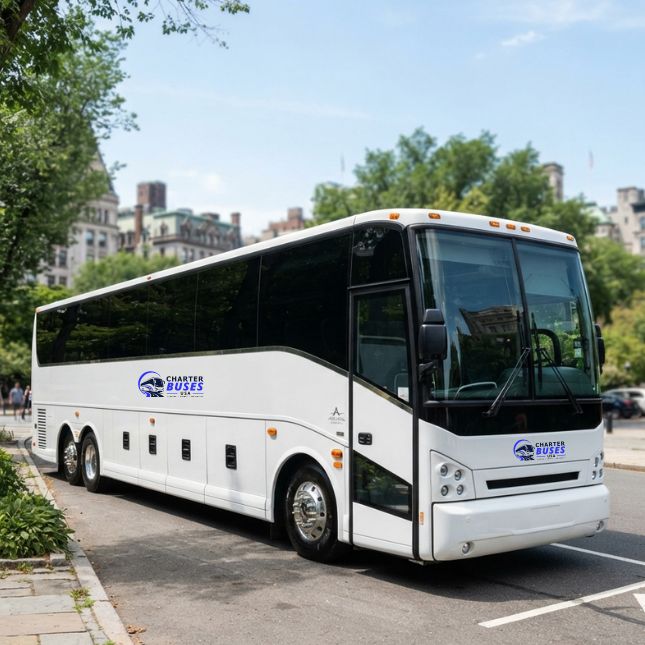
Full Size Charter Bus

HOURLY PRICE$180 – $350
DAILY PRICE$1,500 – $2,800
Passenger Capacity50–56 Passengers
Best ForLarge Groups & Long Distance Trips
AmenitiesReclining Seats, Wi-Fi, USB Charging, Power Outlets, TV Monitors, Climate Control
DriverIncluded
🛡️

Licensed & Insured

👨‍✈️

Professional Drivers

Fast Free Quotes

🇺🇸

Nationwide Service

📞

24/7 Reservation Support

🚌

Modern Fleet

🎯

Dedicated Trip Specialists

Description

Reliable Charter Bus Rentals for Comfortable Group Transportation

When your group needs dependable transportation, a full-size charter bus offers one of the most comfortable and efficient ways to travel together. Whether you're organizing a corporate event, wedding, school trip, sports tournament, church outing, sightseeing tour, convention, airport transfer, or private group excursion, traveling in one vehicle simplifies coordination while creating a more enjoyable experience for every passenger.

At Charter Buses USA, we help groups arrange professionally operated charter bus rentals across the United States. Every itinerary is different, which is why our transportation specialists work closely with customers to recommend the right vehicle based on passenger count, luggage requirements, travel distance, and onboard amenity preferences. Rather than offering one-size-fits-all transportation, we focus on matching each trip with a practical solution designed around your schedule.

A modern charter bus is designed specifically for group travel. Spacious reclining seats, climate-controlled interiors, generous luggage compartments, wide aisles, panoramic windows, and available onboard amenities create a comfortable environment whether you're traveling across town or across multiple states. Instead of coordinating carpools or multiple rental vehicles, everyone departs together, arrives together, and enjoys a more organized journey.

Group transportation is about more than moving passengers from one location to another. It helps reduce parking challenges, minimizes logistical confusion, keeps travel schedules organized, and allows travelers to spend more time enjoying the trip rather than worrying about directions or traffic. For event organizers, schools, businesses, and tour planners, this can make planning significantly easier.

Our nationwide transportation network supports local, regional, and long-distance charter bus rentals. From single-day transportation to multi-day itineraries, our goal is to provide dependable service backed by experienced reservation specialists who assist with planning, scheduling, and transportation coordination from beginning to end.

Whether you're planning months in advance or arranging transportation for an upcoming event, choosing the right charter bus helps create a safer, more comfortable, and better-organized travel experience for your entire group.

Why Groups Prefer Charter Buses

40–56 Passenger Capacity

Ideal for medium and large groups traveling together.

Professional CDL Drivers

Transportation provided by experienced commercial drivers.

Large Luggage Storage

Perfect for airport transfers, tours, and extended trips.

Comfortable Interiors

Reclining seats, climate control, and available onboard amenities.

Nationwide Service

Available for local, regional, and long-distance group transportation.

Designed for Comfortable, Efficient and Organized Group Travel

A full-size charter bus is much more than a large passenger vehicle. It is designed to make group transportation easier by combining passenger comfort, efficient logistics, professional operation, and modern travel amenities into one coordinated travel solution. Whether your trip lasts one hour or several days, the right vehicle can significantly improve the overall travel experience.

🪑

Comfortable Passenger Seating

Charter buses are built for extended travel, offering spacious reclining seats, generous legroom, overhead storage, wide aisles, and climate-controlled interiors. Instead of feeling crowded during long journeys, passengers can relax, read, work, socialize, or simply enjoy the ride. Comfortable seating helps reduce travel fatigue and creates a more enjoyable experience for every member of the group.

🧳

Large Luggage Capacity

Unlike many transportation options, charter buses provide dedicated luggage compartments designed to accommodate suitcases, equipment, instruments, sports gear, conference materials, and other travel essentials. This helps keep the passenger cabin organized while ensuring everyone has sufficient personal space throughout the journey.

📍

One Vehicle, One Schedule

Coordinating several personal vehicles often leads to delays, parking challenges, and communication issues. A charter bus keeps everyone together from departure through arrival, simplifying logistics for organizers while allowing passengers to focus on enjoying the trip instead of navigating unfamiliar roads.

💼

Ideal for Business Travel

Corporate groups frequently choose charter buses because they provide an organized environment for conferences, meetings, training events, client visits, and employee transportation. Available amenities such as Wi-Fi, charging outlets, and comfortable seating allow passengers to remain productive while traveling between destinations.

🛣️

Built for Long-Distance Trips

Modern motorcoaches are engineered for both regional and interstate travel. Professional suspension systems, comfortable interiors, climate control, and available onboard restrooms make longer journeys considerably more comfortable than coordinating multiple passenger vehicles.

👨‍✈️

Professional Transportation Experience

Every trip benefits from experienced commercial drivers who manage navigation, traffic conditions, pickup schedules, and route planning. Having a professional behind the wheel allows passengers to relax throughout the journey while organizers spend less time coordinating transportation logistics.

Every Trip Has Different Transportation Requirements

No two group trips are exactly alike. A university campus visit has different transportation priorities than a wedding celebration, and a corporate conference often requires different onboard amenities than a sports tournament or sightseeing tour. Selecting the appropriate charter bus means considering passenger count, travel distance, luggage requirements, accessibility needs, pickup locations, and itinerary complexity rather than simply choosing the largest available vehicle.

Our reservation specialists help evaluate these factors before recommending a charter bus that aligns with your travel plans. This consultative approach ensures your transportation supports the purpose of your trip while providing a comfortable experience for every passenger.

Whether you're planning transportation for dozens of attendees or coordinating a multi-day itinerary with several destinations, choosing a professionally operated charter bus can simplify planning, improve travel efficiency, and create a more enjoyable journey from start to finish.

Vehicle Details

Charter Bus Amenities Designed Around the Passenger Experience

A full-size charter bus combines high passenger capacity with features intended to make group travel more comfortable, organized, and practical. Exact specifications vary by vehicle model and operator, but most modern motorcoaches offer a combination of spacious seating, luggage storage, climate control, entertainment options, and conveniences suited to local or long-distance transportation.

🪑

Reclining Passenger Seats

High-back reclining seats help passengers settle in comfortably during both short transfers and extended journeys. Many buses also provide armrests, footrests, reading lights, and more legroom than standard passenger vehicles. These features can be especially valuable for senior groups, corporate travelers, athletic teams, students, and tour passengers spending several hours on the road.

❄️

Climate-Controlled Interior

Heating and air conditioning help maintain a comfortable passenger cabin through changing weather conditions and travel regions. Climate control is particularly important when groups travel during hot summers, cold winters, or across several states where temperatures may change significantly over the course of the itinerary.

🧳

Underfloor Luggage Compartments

Large exterior storage bays allow passengers to bring suitcases, presentation materials, athletic equipment, musical instruments, event supplies, or other bulky belongings without overcrowding the seating area. This is one of the primary reasons full-size motorcoaches are well suited to airport transfers, multi-day tours, sports travel, and long-distance group transportation.

🎒

Overhead Storage Racks

Overhead parcel racks provide convenient space for smaller personal items such as backpacks, handbags, jackets, documents, and travel accessories. Keeping these belongings nearby allows passengers to access essentials during the trip while maintaining a cleaner and less cluttered aisle.

📶

Available Wi-Fi Connectivity

Wi-Fi may be available on select charter buses, allowing passengers to check email, review presentations, communicate with event organizers, stream content, or remain connected during travel. Corporate groups and university travelers often request this feature, although service quality may vary depending on the route, mobile coverage, and vehicle equipment.

🔌

Power Outlets and USB Charging

Available charging outlets help passengers keep phones, tablets, laptops, and other devices powered throughout the journey. This amenity can support business productivity, digital ticket access, communication with family members, navigation at the destination, and entertainment during longer trips.

📺

Entertainment Systems

Select coaches may include television monitors, DVD or multimedia systems, and a public-address system. These features can be useful for tour narration, student programming, company announcements, team briefings, presentations, or group entertainment while traveling between stops.

🚻

Available Onboard Restroom

Many full-size motorcoaches are equipped with an onboard restroom, providing additional convenience on extended routes. A restroom can reduce the need for frequent unscheduled stops, although planned breaks may still be included for meals, stretching, driver requirements, or passenger comfort.

🪟

Panoramic Windows

Large windows create an open, pleasant cabin environment and provide passengers with clearer views of cities, landscapes, campuses, landmarks, and scenic routes. This can make sightseeing tours, national park trips, destination events, and regional travel more enjoyable.

ADA-Accessible Options

Wheelchair-lift-equipped charter buses and accessible seating configurations may be requested for groups that include passengers with mobility needs. Because accessible vehicles may require advance coordination, organizers should provide information about wheelchair spaces, lift requirements, mobility devices, and boarding assistance as early as possible.

What May Be Included With Your Charter Bus Rental

A charter bus rental is arranged around a defined itinerary rather than a simple vehicle handover. Your quote is generally based on the requested schedule, route, vehicle requirements, operating time, and trip details. Depending on the reservation, the transportation arrangement may include several of the following service components.

A professionally operated vehicle matched to your group size
Pickup and drop-off service based on the confirmed itinerary
Route coordination for scheduled destinations and planned stops
Interior climate control and standard passenger seating
Exterior luggage storage when supported by the selected bus
Trip assistance from reservation and transportation specialists
Optional amenity requests based on availability
Local, regional, one-way, round-trip, or multi-day routing
Additional vehicle coordination for larger passenger groups
Important: Amenities are not identical on every bus. Wi-Fi, electrical outlets, restrooms, entertainment equipment, wheelchair lifts, and specific seat configurations should be requested when booking and confirmed in your final reservation details.
Capacity Planning

How Many Passengers Can a Full-Size Charter Bus Carry?

Most full-size charter buses accommodate approximately 40 to 56 passengers, although the exact seating capacity depends on the vehicle model, interior configuration, accessibility layout, and operator. Choosing the correct bus is not only about matching the number of seats to the number of travelers. Luggage volume, equipment, comfort expectations, pickup logistics, and the length of the journey should also influence the final vehicle selection.

Typical Charter Bus Capacity Range

40–56 Passengers
40 Smaller full-size coach configuration
47 Comfort-focused group travel layout
52 Common high-capacity motorcoach size
56 Typical maximum passenger capacity

A 56-passenger charter bus is often selected for large school groups, corporate delegations, wedding guests, sports teams, university organizations, convention attendees, church groups, and tour programs. Groups with fewer passengers may still prefer a full-size coach when they need substantial luggage space, premium seating comfort, an onboard restroom, or amenities that may not be available on smaller vehicles.

For example, a group of 34 airport travelers carrying large suitcases may benefit more from a full-size motorcoach than a smaller minibus. Similarly, an athletic team with players, coaches, medical staff, and bulky equipment may need additional storage even when the passenger count alone appears to fit a smaller vehicle.

1

Count Every Passenger

Include group leaders, chaperones, coordinators, coaches, guides, staff members, and any additional passengers who may join during the trip. Avoid booking a bus with no spare capacity if attendance is still changing.

2

Evaluate Luggage and Equipment

Suitcases, sports gear, instruments, presentation materials, coolers, mobility devices, and event supplies can influence the type of bus required. Share unusually large items before the reservation is finalized.

3

Consider Trip Duration

A short local transfer may require fewer amenities, while a long-distance or multi-day trip may justify reclining seats, more legroom, charging options, Wi-Fi, entertainment systems, and a restroom.

4

Plan for Accessibility

Wheelchair spaces can affect the final seating layout. Inform the reservation team about lift access, mobility devices, transfer assistance, and the number of accessible spaces needed as early as possible.

Why Accurate Passenger Counts Matter

An accurate passenger count helps determine vehicle availability, seating requirements, pricing, loading time, and whether more than one bus is necessary. Last-minute attendance changes can affect the suitability of the reserved vehicle, particularly during peak travel periods when larger coaches may have limited availability.

Organizers should confirm attendance with participants before finalizing transportation whenever possible. For schools and youth programs, this includes students, teachers, chaperones, support staff, and approved guests. For weddings, the count should include guests, members of the wedding party, coordinators, photographers, and vendors who may use the shuttle. Corporate planners should include employees, speakers, clients, and event staff.

When attendance is uncertain, allowing a modest seating buffer may provide greater flexibility. However, reserving substantially more capacity than needed can affect cost. The most efficient approach is to provide the reservation specialist with a realistic minimum, expected, and maximum passenger estimate so the recommendation can reflect both current needs and possible changes.

Charter Buses USA can also help coordinate multiple vehicles for large events. Each bus may be assigned a route, hotel, terminal, team, department, or passenger group. Clear signage, group leader contact information, and detailed boarding instructions can make multi-bus transportation easier to manage and reduce confusion at busy pickup points.

Trip Applications

When a Full-Size Charter Bus Is the Most Practical Transportation Choice

Full-size charter buses are suitable for far more than long sightseeing tours. Their passenger capacity, luggage storage, onboard comfort, and ability to follow a customized itinerary make them useful for business travel, educational programs, celebrations, sports transportation, airport service, community outings, and complex multi-stop events.

01
💼

Corporate Events, Conferences and Employee Transportation

Businesses use charter buses to move employees, executives, clients, speakers, and event attendees between offices, hotels, airports, convention centers, training facilities, restaurants, and entertainment venues. Keeping participants together helps reduce late arrivals, parking complications, mileage reimbursements, and confusion around unfamiliar destinations.

A corporate charter bus can also support productivity while the group is in transit. Available Wi-Fi, charging outlets, reclining seats, and public-address systems may allow passengers to review presentations, communicate with colleagues, receive event instructions, or prepare for the next meeting. For large conferences, multiple buses can be assigned to specific hotels, departments, schedules, or attendee groups.

Companies may also arrange recurring employee shuttle services for office campuses, remote parking areas, construction sites, distribution centers, training programs, or temporary work locations. In these situations, the transportation plan can be developed around shift changes, attendance levels, security procedures, and designated boarding points.

02
💍

Wedding Guest Transportation

Wedding transportation often involves guests staying at different hotels, limited venue parking, several event locations, and strict ceremony timelines. A full-size charter bus can transport large groups between hotels, the ceremony, reception, rehearsal dinner, after-party, and other planned activities.

Shuttle service helps guests avoid driving in unfamiliar areas and allows the couple or planner to create a more predictable arrival and departure schedule. It can be especially useful for rural venues, downtown locations, destination weddings, large resorts, wineries, private estates, and celebrations where parking is restricted.

03
🎓

School Trips and University Travel

Schools, colleges, universities, and youth organizations may use charter buses for educational tours, museum visits, academic competitions, campus tours, student orientation, athletics, performing arts programs, field trips, and multi-day educational travel. Full-size coaches are particularly useful when groups need comfortable seating and storage for backpacks, instruments, uniforms, presentation materials, or overnight luggage.

Transportation organizers can create designated pickup points, passenger lists, chaperone assignments, rest stops, meal breaks, and emergency communication procedures before departure. Keeping students and supervisors together in one coordinated vehicle can simplify attendance checks and reduce the logistical challenges associated with several smaller vehicles.

04
🏆

Sports Teams, Coaches and Support Staff

Athletic groups often need transportation for players, coaching staff, trainers, managers, medical personnel, and equipment. A full-size motorcoach provides passenger capacity along with underfloor storage for uniforms, protective gear, training supplies, coolers, luggage, and other team essentials.

Teams can travel together to tournaments, away games, training camps, championships, airports, hotels, and practice facilities. Reclining seats and climate control can help passengers rest before or after competition, while available Wi-Fi and entertainment systems may support film review, team communication, or downtime during longer trips.

05
✈️

Airport Group Transfers

A charter bus can move large groups between airports, hotels, cruise terminals, campuses, conference venues, or tour departure points. Exterior luggage bays make full-size coaches practical for passengers carrying suitcases, while a coordinated pickup plan can reduce the need for multiple taxis, rideshare vehicles, or rental cars.

Airport transportation should account for terminal access, flight arrival times, baggage collection, group check-in procedures, traffic, and possible delays. Providing airline and flight details during planning can help create a more realistic transfer schedule.

06
🗺️

Private Tours and Sightseeing

Tour operators, travel planners, senior groups, international visitors, clubs, and private organizations often choose charter buses for city tours, national park trips, historical routes, cultural excursions, shopping tours, and multi-city itineraries.

Panoramic windows, comfortable seating, luggage storage, and an available PA system can support a more enjoyable touring experience. The itinerary may include hotels, attractions, restaurants, scenic stops, guided tours, and scheduled breaks.

07
🎤

Concerts, Festivals and Entertainment Events

Large public events can create significant parking and traffic challenges. Charter buses can transport guests, staff, volunteers, performers, production teams, or sponsors from hotels, remote parking lots, campuses, and designated meeting points.

For events with staggered schedules, several buses may operate on assigned routes or departure windows. Detailed loading instructions and group leader contacts help improve coordination in crowded environments.

08

Church Groups and Community Organizations

Churches, nonprofit organizations, senior communities, neighborhood groups, and civic associations may arrange charter buses for retreats, conferences, volunteer projects, conventions, camps, worship events, community celebrations, and regional outings.

Traveling together helps strengthen group interaction and allows organizers to manage attendance, timing, meals, lodging, and activities through one transportation plan. Accessibility options can also be requested when travelers include passengers with mobility needs.

09
🚢

Cruise Transfers and Multi-Day Group Travel

Cruise groups often need transportation between airports, hotels, restaurants, tourist attractions, and passenger terminals. A full-size charter bus can keep the group and its luggage together while reducing the complexity of coordinating numerous smaller vehicles.

Multi-day travel may include several cities, overnight stops, scheduled attractions, meal breaks, hotel check-ins, and changes in passenger activity. These itineraries require careful planning because operating hours, driver schedules, parking, lodging, and route timing may affect the transportation plan.

Full-size coaches are well suited to extended tours because passengers benefit from reclining seats, climate control, larger storage capacity, and available onboard conveniences. Organizers should provide a complete day-by-day itinerary when requesting a quote so the trip can be evaluated accurately.

A Charter Bus May Be a Strong Fit When

Your group includes approximately 36 to 56 passengers.
Passengers are traveling with luggage, equipment, instruments, or event materials.
The itinerary includes regional, interstate, or multi-day travel.
You want everyone to follow one organized departure and arrival schedule.
Passenger comfort is important during a longer journey.
Your destination has limited parking or difficult traffic conditions.

A Smaller Vehicle May Be More Efficient When

The confirmed passenger count is significantly below 36 travelers.
The trip is a short local transfer with little or no luggage.
Pickup points or destinations have narrow roads or restricted vehicle access.
Your group needs frequent movement between nearby locations.
A minibus, shuttle bus, or sprinter van provides sufficient capacity and storage.
The venue has specific vehicle-size limitations that prevent motorcoach access.
Rental Process

How to Plan and Reserve a Charter Bus for Your Group

Renting a charter bus becomes much easier when the trip is planned in clear stages. From submitting basic itinerary information to confirming pickup instructions and managing travel day, each step helps ensure that the selected vehicle, schedule, and service arrangement match the needs of your passengers.

01

Share the Basic Details of Your Trip

Initial Request

The charter bus rental process begins with a clear outline of where your group is traveling, when transportation is needed, and how many passengers are expected. You do not need to have every small detail finalized before requesting a quote, but accurate core information allows the trip to be evaluated more effectively.

Provide the departure date, estimated pickup time, pickup address, destination, expected return time, and anticipated passenger count. For multi-day or multi-stop trips, include the known hotels, venues, restaurants, airports, campuses, attractions, or event locations. A written itinerary is especially helpful for tours, conferences, school travel, sports tournaments, and destination weddings.

You should also mention any luggage, athletic equipment, musical instruments, mobility devices, presentation materials, coolers, or other large items that may affect storage requirements. This information helps determine whether a full-size charter bus, minibus, shuttle bus, sprinter van, or multiple vehicles may be appropriate.

Travel date and estimated departure time
Pickup and destination addresses
Expected passenger count
Luggage and equipment requirements
02

Review the Itinerary and Transportation Logistics

Trip Evaluation

After receiving the initial trip details, the transportation plan can be reviewed for timing, route practicality, vehicle access, operating requirements, and possible scheduling challenges. This stage is important because two trips with the same mileage may require very different levels of coordination.

A simple round-trip transfer may involve one pickup and one destination, while a conference shuttle may include several hotels, repeated loops, different departure windows, and multiple event entrances. A multi-day tour may require driver lodging, parking arrangements, planned rest periods, meal stops, attraction reservations, and coordination across several cities.

Pickup and drop-off locations may also need additional review. Some downtown streets, hotel entrances, airports, campuses, stadiums, historic districts, and private venues have designated motorcoach loading areas or vehicle-size restrictions. Providing exact addresses allows these details to be considered before the trip is confirmed.

Route and mileage review
Pickup and loading-zone evaluation
Driver operating-hour considerations
Multi-stop and multi-day coordination
03

Select the Most Suitable Vehicle

Bus Recommendation

The correct vehicle should support both the passenger count and the practical requirements of the trip. A full-size charter bus is often recommended for groups of approximately 36 to 56 passengers, long-distance routes, multi-day travel, airport transfers with substantial luggage, sports teams carrying equipment, and groups seeking added onboard comfort.

However, the largest vehicle is not automatically the best option. A smaller group traveling a short local route may be better served by a minibus, shuttle bus, or sprinter van. The decision should consider luggage volume, road access, trip duration, passenger mobility, required amenities, and the number of planned stops.

This is also the stage to request optional features such as Wi-Fi, power outlets, USB charging, an onboard restroom, entertainment monitors, a public-address system, or an ADA-accessible vehicle. Because specifications differ between buses, priority amenities should be discussed before the reservation is finalized.

Capacity matched to the passenger count
Storage matched to luggage and equipment
Amenities requested according to trip needs
Multiple vehicles coordinated when required
04

Review the Quote and Confirm the Reservation

Booking Stage

Once the trip has been evaluated, the quote should be reviewed carefully. Confirm that the travel dates, passenger estimate, pickup locations, destinations, operating schedule, vehicle type, and requested amenities match the information you provided.

The quote may be influenced by factors such as mileage, trip duration, driver time, vehicle availability, travel season, parking, tolls, overnight requirements, and itinerary complexity. Organizers should ask questions about any part of the arrangement that is unclear before completing the reservation.

After booking, keep a copy of the confirmed itinerary and reservation information. If the schedule changes, notify the transportation team as early as possible. Changes to dates, times, locations, passenger counts, or additional stops may affect vehicle availability, operating requirements, or the final cost.

Verify dates, times, and addresses
Confirm the requested vehicle and amenities
Review payment and cancellation terms
Report itinerary changes promptly
05

Prepare Passengers for Travel Day

Before Departure

Clear passenger communication can make the boarding process faster and more organized. Share the exact meeting location, reporting time, departure time, luggage instructions, group leader contact information, and any venue-specific loading rules before the day of travel.

Passengers should generally arrive before the scheduled departure so attendance can be checked and luggage can be loaded without delaying the itinerary. Schools, tour groups, sports teams, and corporate organizers may find it helpful to divide passengers into smaller groups with assigned leaders.

For large events using multiple buses, consider assigning each vehicle a number, color, hotel, department, team, or route. Signs, printed passenger lists, mobile messages, and designated boarding coordinators can help reduce confusion at busy locations.

Distribute the pickup location and schedule
Ask passengers to arrive early
Assign group leaders when appropriate
Provide luggage and boarding instructions
06

Board, Travel and Complete the Itinerary

Travel Day

On travel day, passengers board at the confirmed location while luggage and equipment are placed in the appropriate storage areas. The group leader should verify attendance and communicate any important schedule information before departure.

During the journey, the bus follows the confirmed transportation plan, including scheduled stops and approved destinations. Passengers can relax, socialize, work, or enjoy available onboard amenities while the professional driver manages the road and route.

For return trips or multi-day itineraries, group leaders should continue communicating departure times and meeting locations to passengers. Any requested schedule changes should be discussed before they are implemented because additional operating time, mileage, access restrictions, or driver requirements may need to be considered.

Organized passenger boarding
Secure luggage and equipment storage
Travel according to the confirmed itinerary
Coordinate return and multi-day departures

Why a Detailed Itinerary Leads to Better Transportation Planning

A complete itinerary helps identify the appropriate vehicle, realistic travel time, driver requirements, loading areas, parking arrangements, and possible route restrictions. It also reduces the risk of misunderstandings between the organizer, passengers, transportation team, venues, and other vendors.

For complex trips, include addresses rather than only venue names. Add the time passengers should arrive, the actual departure time, estimated loading duration, planned stops, event ending times, hotel check-in information, meal breaks, and any locations where the bus must remain nearby.

The itinerary does not need to remain unchanged forever, but early detail creates a stronger starting point. When changes occur, they can be evaluated against the original schedule instead of rebuilding the transportation plan at the last moment.

Information to Have Ready

1 Departure and return dates
2 Pickup, destination, and stop addresses
3 Expected minimum and maximum passenger count
4 Luggage, equipment, and storage requirements
5 Accessibility and mobility needs
6 Preferred onboard amenities
7 Hotel, venue, airport, or terminal details
8 Primary group leader contact information

Start Planning Your Charter Bus Rental

Share your travel date, passenger count, pickup location, destination, and trip schedule to receive a transportation recommendation based on your group’s actual requirements.

Request a Free Quote
Cost Planning

What Determines the Cost of a Charter Bus Rental?

Charter bus pricing is usually based on the details of the individual trip rather than a single fixed rate. Travel distance, operating time, vehicle size, schedule complexity, season, pickup location, required amenities, and overnight arrangements can all influence the final quote. Understanding these factors makes it easier to build a realistic transportation budget and compare options accurately.

📍

Travel Distance and Route

Mileage is one of the most important pricing factors for regional and long-distance charter bus rentals. A short local transfer may be priced differently from an interstate trip covering several hundred miles. The route may also include toll roads, bridges, ferries, mountain highways, congested downtown areas, or restricted access points that affect operating time and trip planning.

⏱️

Total Operating Time

Some trips are influenced more by time than by mileage. Wedding shuttles, convention transportation, employee shuttles, sports events, and local sightseeing programs may require a bus to remain available for several hours even when the total driving distance is relatively low. Loading time, waiting time, event duration, repeated loops, and late-night returns may all be considered.

🚌

Vehicle Size and Type

A full-size charter bus generally has different operating requirements from a minibus, shuttle bus, school bus, sprinter van, or executive coach. Larger vehicles provide more seating, luggage capacity, and available amenities, but the most efficient option depends on the passenger count and itinerary. Selecting a vehicle that fits the trip can help avoid unnecessary capacity while preserving passenger comfort.

📅

Travel Date and Season

Demand can change throughout the year. Spring school travel, summer tours, wedding season, major conventions, sporting events, holidays, and graduation periods may increase demand for full-size motorcoaches. Weekends and peak event dates can also be busier than ordinary weekdays. Booking earlier may provide a wider range of vehicle options.

🏨

Multi-Day and Overnight Requirements

Multi-day trips may require additional planning for driver lodging, parking, rest periods, and daily operating schedules. Tour organizers should include hotel addresses, check-in times, morning departures, evening returns, meal breaks, and all planned activities. A detailed itinerary helps determine whether the schedule can be completed with one driver or requires additional operating arrangements.

🛣️

Tolls, Parking and Access Fees

Tolls, motorcoach parking, venue permits, airport access fees, terminal charges, and local entry fees may affect the total trip cost. Stadiums, convention centers, cruise terminals, major attractions, downtown hotels, and private venues may have specific loading or parking procedures. These details should be reviewed before the trip whenever possible.

📶

Requested Amenities

Amenities such as Wi-Fi, power outlets, USB charging, an onboard restroom, entertainment systems, wheelchair accessibility, premium seating, or specific equipment may influence vehicle selection and availability. Essential features should be identified before booking rather than requested at the last moment.

🔄

Itinerary Complexity

Multiple pickups, repeated shuttle loops, staggered departures, route changes, special loading requirements, or several vehicles can require more coordination than a simple point-to-point transfer. A detailed and stable schedule allows the quote to reflect the actual service needed and reduces the likelihood of unexpected changes later.

Common Charter Bus Pricing Structures

The method used to calculate a charter bus rental may vary according to the type of trip. These examples are general explanations rather than guaranteed pricing methods. Your final quote should clearly state the service period, itinerary, vehicle type, and any included or additional charges.

Local Service

Hourly Pricing

Hourly pricing may be used for local events, weddings, corporate functions, airport transfers, evening transportation, and shuttle services. A minimum number of service hours may apply even when the actual driving time is shorter.

Distance Travel

Mileage-Based Pricing

Mileage-based pricing may be used for longer routes where the distance traveled is the main operating factor. Total mileage can include travel between the operating location, pickup point, destinations, overnight stops, and return route.

Extended Itineraries

Daily or Trip-Based Pricing

Multi-day tours, school trips, corporate programs, sports travel, and complex itineraries may be quoted by day or as a complete trip. This approach can account for operating time, route distance, overnight requirements, and schedule complexity.

How to Build a More Efficient Transportation Plan

The lowest initial quote is not always the most practical transportation choice. A vehicle that is too small may create storage or capacity problems, while an unrealistic itinerary may lead to delays or added operating time.

The goal should be to match the vehicle, schedule, and route to the actual needs of the group. Accurate information allows the transportation plan to be organized efficiently without sacrificing passenger comfort or trip reliability.

Ways to Manage Charter Bus Costs

1
Book as early as practical

Earlier planning may provide more vehicle choices during busy travel periods.

2
Confirm the passenger count

A realistic count helps prevent paying for unnecessary capacity or booking a vehicle that is too small.

3
Reduce unnecessary waiting time

Accurate event and pickup schedules can help avoid avoidable operating hours.

4
Consolidate pickup points

Using fewer well-organized pickup locations may simplify routing and reduce travel time.

5
Request only essential amenities

Prioritize the features that matter most to your passengers and itinerary.

6
Provide the full itinerary upfront

Complete trip details support more accurate pricing and reduce later revisions.

Why Charter Bus Prices Are Usually Customized

Two groups may reserve the same size bus and still receive different quotes because their trips require different mileage, service hours, operating conditions, parking arrangements, and schedules. A 50-mile airport transfer is not operationally equivalent to a 50-mile wedding shuttle that remains on-site for eight hours. Similarly, a one-day corporate transfer differs from a multi-day tour requiring overnight driver arrangements and repeated stops.

Customized pricing allows the quote to reflect the actual transportation service instead of relying on a general advertised rate that may exclude important trip requirements. When reviewing quotes, compare the itinerary, vehicle type, service period, inclusions, possible additional charges, and change terms rather than focusing only on the headline amount.

Charter Buses USA prepares transportation recommendations around the passenger count, route, travel schedule, storage needs, and requested vehicle features. Providing complete trip details helps create a quote that is clearer, more practical, and better aligned with the group’s expectations.

Safety & Operations

Professional Drivers, Prepared Vehicles and Responsible Trip Planning

Safe charter bus transportation depends on more than the size or appearance of the vehicle. Driver qualifications, vehicle condition, regulatory compliance, realistic scheduling, clear passenger communication, and careful itinerary planning all contribute to a dependable travel experience.

👨‍✈️

Commercial Driver Qualifications

Full-size charter buses are operated by professional commercial drivers who hold the licensing and endorsements required for the vehicle and passenger service. Driver assignment may also consider route type, travel distance, operating schedule, local conditions, and the experience required for the itinerary.

🛠️

Vehicle Inspection and Maintenance

Motorcoaches require regular inspection, maintenance, and attention to critical operating systems. Brakes, tires, lighting, steering, mirrors, emergency equipment, climate systems, doors, and other components should be maintained in accordance with applicable requirements and operating procedures.

Realistic Driver Scheduling

Long-distance and multi-day trips must be planned with realistic operating times. Travel duration, traffic, loading, rest breaks, overnight schedules, and legal driver-hour requirements can influence whether one driver is appropriate or additional arrangements are needed.

🗺️

Route and Access Planning

Motorcoach access can vary by destination. Historic districts, private venues, airports, campuses, hotels, mountain roads, stadiums, and downtown loading zones may have vehicle restrictions or designated entry points. Accurate addresses support better route evaluation.

🚪

Organized Boarding Procedures

Clear boarding instructions reduce confusion and help protect the trip schedule. Group leaders should confirm the meeting point, arrival time, passenger list, luggage process, bus identification, and emergency contact information before departure.

Accessibility Coordination

Passengers requiring wheelchair lifts, mobility-device storage, accessible seating, or boarding assistance should be identified early. Accessible bus configurations can affect capacity and availability, so advance coordination is important.

How Safety Considerations Fit Into the Rental Process

Transportation safety is supported throughout the planning process. The vehicle, route, schedule, passenger needs, and operating conditions should be reviewed together rather than treated as separate details.

01

Trip Information

Passenger count, dates, locations, travel distance, luggage, and accessibility requirements are collected.

02

Operational Review

The route, timing, loading points, planned stops, and itinerary complexity are evaluated.

03

Vehicle & Driver Match

A suitable vehicle and professional driver arrangement are selected for the trip requirements.

04

Travel-Day Coordination

Passengers board at the confirmed location and follow the planned transportation schedule.

What Group Organizers Can Do

Provide accurate addresses and a complete itinerary before the trip.
Confirm the passenger count, including leaders, chaperones, and staff.
Communicate accessibility needs and mobility-device requirements early.
Verify that venues can accommodate a full-size motorcoach.
Share boarding instructions and ask passengers to arrive before departure.
Report schedule, route, or attendance changes as soon as possible.

What Passengers Should Remember

Arrive at the designated boarding point at the requested reporting time.
Keep aisles, exits, and emergency equipment unobstructed.
Store luggage and personal belongings in the appropriate areas.
Follow driver and group-leader instructions during boarding and stops.
Remain aware of scheduled return times at attractions, meals, and events.
Report concerns or lost items to the group leader or driver promptly.

Safety Claims Should Be Specific and Verifiable

A charter bus page should avoid vague promises such as “the safest buses in America” or “zero-risk transportation.” No transportation provider can remove every travel risk, and unsupported superlatives may weaken customer trust.

A stronger approach is to explain the operational practices that contribute to responsible transportation: professional commercial drivers, maintained vehicles, practical scheduling, clear trip details, accessibility coordination, and organized passenger communication.

Charter Buses USA works with owned vehicles and qualified transportation partners to arrange service based on the itinerary, passenger requirements, vehicle availability, and operating conditions. Specific vehicle details and requested features should be confirmed before the reservation is finalized.

Vehicle Comparison

Charter Bus, Minibus or Shuttle Bus: Which Vehicle Fits Your Trip?

Choosing a group transportation vehicle involves more than comparing seat counts. Travel distance, luggage volume, route access, passenger comfort, trip duration, accessibility, and requested amenities can all affect which vehicle is most practical. A full-size charter bus is often the strongest choice for larger groups and longer journeys, while minibuses and shuttle buses can be more efficient for smaller groups and local transportation.

Best for medium groups
🚐

Minibus

Typically 18–35 Passengers

A minibus provides a balance between passenger capacity and maneuverability. It may be suitable for local corporate travel, wedding transportation, hotel transfers, campus events, private outings, and short regional journeys. Some minibuses provide upgraded seating and charging features, although storage is usually more limited than on a full-size motorcoach.

Practical for medium-size passenger groups
Easier access to some urban and venue locations
Well suited to short and moderate-distance trips
Limited luggage storage on some models
Best for local circulation
🔄

Shuttle Bus

Capacity Varies by Model

Shuttle buses are commonly used for repeated short-distance movement between hotels, offices, parking lots, airports, campuses, event venues, hospitals, and private facilities. Their layouts and capacities vary, with some prioritizing rapid boarding and frequent stops rather than long-distance comfort or extensive luggage storage.

Designed for shorter routes and repeated loops
Useful for hotels, parking areas, and campuses
Efficient boarding for frequent passenger movement
Amenities and storage differ significantly by model
Comparison Factor Full-Size Charter Bus Minibus Shuttle Bus
Typical Capacity Approximately 40–56 passengers Approximately 18–35 passengers Varies widely by vehicle configuration
Best Travel Distance Local to long distance Local and regional travel Primarily local and short-distance routes
Luggage Capacity Large underfloor luggage compartments and overhead racks Limited or moderate storage depending on model Often limited; some airport-focused models offer storage
Passenger Comfort High-back reclining seating, climate control, and added legroom Comfortable seating, with features varying by model Usually designed for practical short-distance movement
Onboard Restroom Available on many full-size coaches Usually unavailable Usually unavailable
Wi-Fi and Charging Available on select vehicles Available on some upgraded models May be available, depending on configuration
Venue Access Requires suitable motorcoach loading and turning space More maneuverable in many urban environments Well suited to repeated access at local pickup points
Common Uses Long-distance tours, schools, sports, corporations, weddings, airports Corporate outings, wedding groups, campus trips, local events Hotels, campuses, airports, employee loops, parking transfers
Best Overall Advantage Capacity, storage, and long-distance comfort in one vehicle Efficient transportation for medium-size groups Practical circulation between nearby locations

Why a Full-Size Charter Bus May Be Worth Choosing for a Smaller Group

Passenger count is important, but it should not be the only deciding factor. A group of 30 to 35 travelers may still benefit from a full-size coach when passengers have large suitcases, sports equipment, musical instruments, mobility devices, presentation materials, or supplies that require underfloor storage.

Trip duration also matters. Travelers may appreciate reclining seats, an onboard restroom, charging access, and greater cabin space during a journey lasting several hours. A smaller vehicle may technically have enough seats while providing less storage or fewer comfort features than the itinerary requires.

The group should also consider future attendance changes. Booking a vehicle with no available seats may create a problem when additional guests, chaperones, staff members, coaches, or coordinators are added. A realistic capacity buffer can provide flexibility without requiring a last-minute vehicle change.

Questions to Ask Before Selecting a Vehicle

1
How many people are traveling? Count passengers, staff, leaders, chaperones, guides, and support personnel.
2
How much luggage will the group bring? Consider suitcases, athletic gear, instruments, mobility devices, and event supplies.
3
How long will passengers be on the road? Longer trips may require better seating, climate control, charging, and restroom access.
4
Can the destination accommodate a large bus? Check loading areas, road width, height limits, parking, gates, and turning space.
5
Are accessibility features required? Wheelchair lifts and accessible seating should be requested during planning.
01

For Long-Distance Travel

A full-size motorcoach is generally the most suitable option when the group will spend several hours on the road, travel between states, or follow a multi-day itinerary. The combination of seating comfort, luggage storage, climate control, and available restroom access supports a more practical journey.

02

For Local Event Transportation

A minibus may be more efficient for medium-size groups traveling between hotels, offices, restaurants, wedding venues, or nearby attractions. It can provide comfortable transportation while requiring less loading and maneuvering space than a full-size coach.

03

For Repeated Shuttle Loops

A shuttle bus may work well when the primary goal is moving passengers repeatedly between nearby locations. Examples include remote parking service, hotel-to-venue transportation, campus circulation, employee routes, and short airport or terminal transfers.

Vehicle Names and Specifications Can Vary

Terms such as charter bus, motorcoach, coach bus, minibus, and shuttle bus are sometimes used differently across transportation companies. Two vehicles described with the same name may have different passenger capacities, luggage compartments, seating layouts, accessibility features, and onboard amenities.

For that reason, customers should review the actual vehicle specifications rather than relying on the category name alone. Confirm the seating capacity, storage arrangement, restroom availability, accessibility configuration, and priority amenities before completing the reservation.

Charter Buses USA evaluates vehicle recommendations according to the passenger count, route, trip duration, luggage, destination access, and requested features. This helps ensure that the selected vehicle supports the complete transportation plan rather than meeting only the minimum seating requirement.

Frequently Asked Questions

Answers to Common Questions About Renting a Charter Bus

Groups often have questions about capacity, pricing, luggage, amenities, accessibility, booking timelines, travel distance, and itinerary changes. The answers below explain how full-size charter bus rentals are generally planned and what information you should confirm before booking.

A full-size charter bus typically accommodates approximately 40 to 56 passengers. The exact capacity depends on the bus model, seating layout, accessibility configuration, and operator. A wheelchair-accessible layout may reduce the number of standard passenger seats because space must be provided for mobility devices.

Organizers should count every traveler, including passengers, guides, teachers, chaperones, coaches, event staff, and group leaders. When attendance is still changing, provide the expected minimum and maximum passenger count so the most practical vehicle can be recommended.

Charter bus rentals are generally priced according to the individual trip rather than one nationwide fixed rate. Cost factors may include mileage, service hours, vehicle size, travel date, local demand, pickup location, itinerary complexity, tolls, parking, overnight requirements, and requested amenities.

A short point-to-point transfer may be calculated differently from a wedding shuttle that operates for several hours or a multi-day tour covering several states. Providing a complete itinerary helps produce a clearer and more accurate quote.

It is generally helpful to request transportation as early as practical, especially for spring school travel, summer tours, weddings, holidays, conventions, graduations, major sporting events, and other high-demand periods. Earlier booking may provide a wider selection of vehicle sizes and amenities.

Last-minute transportation may still be available, but vehicle choice can be limited. Groups requiring several buses, wheelchair accessibility, specific technology, or a full-size coach during a busy weekend should begin planning earlier whenever possible.

Yes. A charter bus rental includes a professional commercial driver assigned to operate the vehicle according to the confirmed itinerary. Customers do not drive or take possession of the bus as they would with a standard vehicle rental.

Driver scheduling is influenced by travel time, service hours, route distance, planned stops, overnight arrangements, and applicable operating requirements. Longer or more complex trips may require additional planning.

Many full-size motorcoaches have an onboard restroom, but this feature is not guaranteed on every vehicle. Restrooms are more commonly available on larger coaches designed for regional and long-distance transportation.

An onboard restroom can reduce the need for unscheduled stops, but organizers may still include planned breaks for meals, stretching, passenger comfort, and driver requirements. Request restroom availability before confirming the reservation.

Wi-Fi may be available on select charter buses. Availability depends on the specific vehicle and operator, and connection quality may vary according to the route and mobile network coverage.

Corporate groups, university travelers, conference attendees, and long-distance passengers often request Wi-Fi. Because it is not a standard feature on every coach, it should be listed as a priority during the quote process and confirmed in the reservation details.

Power outlets and USB charging are available on many newer or upgraded charter buses, but the number, location, and type of charging connection can vary. Some buses provide outlets near each seat, while others have fewer shared charging points.

Passengers should bring compatible chargers and consider carrying portable battery packs when device access is essential. Charging features should be requested and confirmed before travel.

Full-size charter buses usually offer large underfloor luggage compartments and overhead racks for smaller personal items. This makes them suitable for airport transfers, cruise groups, sports teams, performing arts groups, educational tours, and multi-day travel.

Storage capacity varies by bus model. Inform the reservation specialist about large suitcases, athletic equipment, instruments, coolers, presentation materials, mobility devices, or unusually shaped items so storage requirements can be evaluated before booking.

Food and non-alcoholic beverages may be permitted on some buses, but policies vary by operator and trip. Groups should confirm restrictions before departure, particularly for hot meals, glass containers, alcohol, coolers, or items likely to spill.

Organizers may be responsible for keeping the bus clean and ensuring that passengers dispose of waste properly. For longer trips, planned meal stops may be more practical than serving full meals onboard.

ADA-accessible charter buses with wheelchair lifts and designated mobility-device spaces may be available upon request. Accessible vehicles should be arranged in advance because availability can be more limited than standard buses.

Provide the number of wheelchair users, mobility-device dimensions, transfer requirements, boarding assistance needs, and any additional seating considerations. An accessible layout may reduce the vehicle's standard seating capacity.

Yes. Charter bus itineraries can include multiple pickups, destinations, meal breaks, hotels, attractions, event venues, airports, campuses, or other scheduled stops. Every stop should be included in the itinerary provided for the quote.

Additional stops can affect mileage, service hours, route planning, parking, and driver schedules. Last-minute stops may not always be possible, especially when they create significant detours or extend the operating schedule.

A bus may remain available during an event when this is included in the confirmed service schedule and suitable parking is available. This arrangement is common for weddings, corporate events, sporting events, tours, school trips, and group outings.

Waiting time contributes to the overall operating period. Some venues do not allow buses to remain onsite, so organizers may need to arrange off-site motorcoach parking or a later return time.

Itinerary changes may be possible, but they should be reported as early as possible. Changes to dates, pickup times, addresses, mileage, service hours, destinations, or vehicle requirements may affect availability and pricing.

Do not assume that the driver can accept significant schedule or route changes on travel day. Updated arrangements should be reviewed and confirmed through the appropriate transportation contact.

Yes. One-way charter bus transportation can be arranged for airport transfers, cruise departures, university travel, group relocations, tours, conferences, special events, and other transportation needs.

Pricing is not necessarily based only on passenger travel mileage. The operator may need to consider the vehicle's positioning before pickup and its return after the passengers are dropped off.

Full-size motorcoaches are commonly used for interstate and long-distance group transportation. Trips may include several states, multiple cities, overnight stays, and a combination of hotels, attractions, event venues, and airports.

Long-distance itineraries require realistic travel times and driver scheduling. Provide a complete day-by-day plan so mileage, operating hours, rest periods, lodging, parking, and route conditions can be considered.

Yes. Multiple buses can be coordinated for conventions, corporate events, schools, universities, weddings, sports tournaments, festivals, tours, and large private groups.

Each bus may be assigned a hotel, route, department, team, passenger list, or departure time. Clear signage, designated group leaders, loading maps, and driver communication can improve multi-bus coordination.

Passenger seating, child-restraint requirements, and applicable rules can vary according to the vehicle, trip, age of the passengers, and jurisdiction. Organizers should provide the ages of young travelers and confirm any child-seat or restraint requirements before booking.

Schools, camps, youth organizations, and family groups should also establish passenger lists, chaperone assignments, emergency contacts, and boarding procedures in advance.

Seat-belt availability depends on the specific vehicle, its age, configuration, and applicable requirements. Some modern motorcoaches are equipped with passenger restraints, while other vehicles may have different seating systems.

When seat belts are a priority for your group, request them during the quote process and confirm the final vehicle specifications before departure.

You may request a particular vehicle style, color, seating layout, or model, but exact equipment is subject to availability. Transportation providers may substitute a comparable vehicle when operational needs, maintenance, scheduling, or availability require a change.

Focus first on essential specifications such as capacity, luggage storage, accessibility, restroom availability, and required onboard features. Cosmetic preferences should be treated as secondary unless they are essential to the event.

A useful quote request should include:

  • Travel date and estimated schedule
  • Pickup and destination addresses
  • All planned stops
  • Expected passenger count
  • Trip type and travel purpose
  • Luggage or equipment requirements
  • Accessibility needs
  • Preferred amenities
  • Hotel and overnight details for multi-day travel

An early estimate can sometimes be prepared with partial details, but the quote may need revision when the final itinerary becomes available.

Yes. Charter buses are well suited to airport group transfers because they can transport many passengers and their luggage in one vehicle. They are frequently used for corporate groups, sports teams, school programs, destination weddings, cruise passengers, conventions, and tour groups.

Provide the airport, airline, terminal, flight number, arrival or departure time, and estimated baggage-collection period. Airport loading rules and terminal access may influence the pickup plan.

A full-size charter bus can be used for local transportation, particularly when the group is large, passengers have luggage, or comfort is important. Common local uses include conferences, weddings, festivals, corporate events, school activities, sports events, and airport transfers.

For smaller groups or repeated short-distance loops, a minibus or shuttle bus may be more efficient. The vehicle recommendation should consider both passenger count and practical route requirements.

Delays can affect the remaining itinerary, venue reservations, return schedule, driver operating time, and total service period. The group leader should communicate delays as soon as they are known.

Passengers should receive a reporting time earlier than the scheduled departure so attendance, luggage loading, and boarding can be completed without unnecessary delay.

Full-size charter buses often provide large luggage compartments that can accommodate athletic equipment, uniforms, instruments, staging materials, performance supplies, and other group belongings.

Oversized, fragile, valuable, or unusually shaped equipment should be disclosed before booking. Confirm whether cases, racks, special loading procedures, or an additional vehicle will be required.

Traveling in one coordinated vehicle can reduce parking problems, navigation mistakes, inconsistent arrival times, mileage reimbursement, and communication challenges. Everyone follows the same schedule and arrives at the same designated location.

A charter bus also allows passengers to rest, socialize, work, or enjoy the trip while a professional driver manages the route. For organizers, centralized transportation can make attendance, timing, and event logistics easier to control.

Confirm the Details That Matter Most to Your Group

Charter buses are not identical. Seating capacity, luggage storage, Wi-Fi, charging outlets, restroom availability, wheelchair accessibility, entertainment equipment, and interior configuration can vary between vehicles.

Avoid relying only on a general vehicle category or stock photograph. Essential features should be listed in the quote request and verified as part of the reservation. This is especially important for accessible travel, long-distance trips, airport groups, corporate programs, and passengers carrying substantial luggage or equipment.

Still Have Questions About Your Trip?

Speak with a transportation specialist about your passenger count, route, schedule, vehicle options, storage requirements, and requested amenities.

Request Transportation

Get a Charter Bus Quote Built Around Your Trip

Tell us where your group is traveling, how many passengers are expected, and what your itinerary requires. Our reservation team will review your trip details and help identify a suitable charter bus or alternative vehicle based on capacity, luggage, distance, accessibility, and availability.

📍
Share Your Route Include pickup addresses, destinations, stops, hotels, airports, venues, and return locations.
👥
Confirm Your Group Size Provide the expected passenger count and any possible attendance changes.
🧳
Describe Storage Needs Tell us about suitcases, equipment, instruments, mobility devices, or event supplies.
Request Essential Features Identify accessibility needs, restroom preferences, Wi-Fi, charging, or other priority amenities.
Free Quote Request

Tell Us About Your Charter Bus Trip

Complete the form with as much information as currently available. Your itinerary can be updated as additional trip details are finalized.

    One Way TripRound Way Trip

    Your trip information is used to review transportation requirements and respond to your quote request. Submitting the form does not complete a reservation.
    Nationwide Service Local and long-distance transportation
    Professional Drivers Commercially qualified operators
    Vehicle Options Solutions for different group sizes
    Trip Support Itinerary-focused planning assistance
    Vehicle availability notice: Passenger capacity, vehicle model, interior layout, luggage space, accessibility configuration, Wi-Fi, electrical outlets, entertainment equipment, and restroom availability differ by vehicle. Request essential features when obtaining your quote and verify them in the final reservation details.