
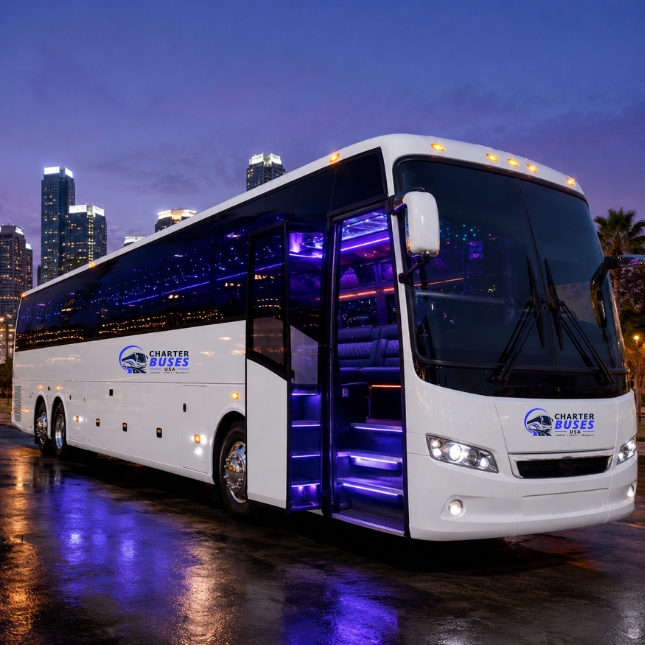
Keep Everyone Together
Guests do not have to split into separate vehicles, exchange changing locations, or arrive at different times. The group follows one shared route and schedule.
| HOURLY PRICE | $200 – $450 |
|---|---|
| DAILY PRICE | $1,600 – $3,500 |
| Passenger Capacity | 15–40 Passengers |
| Best For | Birthday Parties, Bachelor Parties, Bachelorette Parties, Weddings, Proms, Homecoming Events, Nightlife Tours, Wine Tours, Brewery Tours, Casino Trips, Concert Transportation, Graduation Celebrations, Holiday Parties, Corporate Events, Private Celebrations |
| Amenities | LED Mood Lighting, Fiber Optic Lighting, Luxury Leather Seats, Premium Sound System, Bluetooth Audio, Flat-Screen TVs, USB Charging Ports, Power Outlets, Climate Control, Dance Pole (Available on Select Buses), Mini Bar Area (Non-Alcoholic Setup), Tinted Windows, Privacy Divider, Cup Holders |
| Seating | Premium Wraparound Leather Seating with Spacious Lounge Layout |
| Luggage Capacity | Limited Storage for Personal Bags and Small Items |
| Interior | Luxury Lounge Interior with Ambient LED Lighting and Premium Finishes |
| Driver | Included |
| Ideal Group Size | Small, Medium, and Large Private Groups Celebrating Special Occasions |
Licensed & Insured
Professional Drivers
Fast Free Quotes
Nationwide Service
24/7 Reservation Support
Modern Fleet
Dedicated Trip Specialists
A party bus rental gives your group more than transportation. It creates one shared space where the celebration can begin at pickup, continue between stops, and stay organized until everyone reaches the final destination.
Charter Buses USA helps groups arrange party bus transportation for birthdays, weddings, bachelor and bachelorette parties, prom nights, concerts, nightlife outings, corporate celebrations, winery trips, sporting events, casino visits, family gatherings, and other private occasions. Instead of dividing guests among several cars, dealing with parking in busy entertainment districts, or asking members of the group to drive, everyone can travel together in one professionally operated vehicle.
Each trip is planned around the actual event schedule. Your reservation can include one pickup point, several neighborhood pickups, venue-to-venue transportation, dining stops, photo locations, hotel transfers, or a late-night return. This flexibility makes a party bus especially useful for groups that want a more coordinated experience without depending on rideshare availability or managing multiple drivers.
Available features vary by vehicle, but many party buses may include wraparound or perimeter seating, premium sound systems, decorative lighting, climate control, privacy glass, multimedia connections, cup holders, charging options, and spacious interiors designed for social group travel. Our reservation team can help match your group with an appropriate vehicle based on passenger count, destination, trip duration, luggage needs, desired amenities, and local availability.
Guests do not have to split into separate vehicles, exchange changing locations, or arrive at different times. The group follows one shared route and schedule.
A party bus can simplify transportation in nightlife districts, downtown areas, event venues, concert zones, and other locations where parking may be limited or expensive.
Your group can focus on the occasion while a professional driver manages the vehicle, follows the planned itinerary, and transports passengers between stops.
Build a transportation plan around dinners, ceremonies, entertainment venues, photo stops, hotels, private residences, or several destinations in one evening.
Using separate cars may appear simple at first, but group transportation becomes more complicated once pickup locations, parking, traffic, changing destinations, late arrivals, and return travel are added to the plan. A professionally driven party bus gives the entire group one organized transportation solution.
Separate vehicles can work for small, simple trips, but they often create unnecessary coordination problems when the event includes multiple stops, crowded venues, nightlife districts, or a larger guest list.
A party bus keeps passengers together and gives the group one itinerary, one vehicle, and one professional driver. This makes the transportation plan easier to follow before, during, and after the celebration.
When guests share the same vehicle, the organizer has fewer arrival times, drivers, parking locations, and route changes to manage.
Instead of splitting the group into small cars, a party bus gives passengers a common space to talk, listen to music, and enjoy the occasion together.
A planned final departure can help the group leave the venue together and return to the selected drop-off points without arranging several last-minute rides.
The value of a party bus becomes even clearer when an event includes several destinations. A birthday itinerary might begin with residential pickups, continue to dinner, move to an entertainment venue, and finish with hotel drop-offs. A wedding itinerary may involve a hotel, ceremony location, photo site, reception venue, and after-party. A bachelor or bachelorette celebration may include several nightlife stops before the final return.
Coordinating these movements with separate vehicles can create repeated delays and confusion. With one party bus rental, the route can be organized before the event. Guests know where to meet, the driver receives the planned stops, and the group can move from one location to the next without restarting the transportation process each time.
This does not mean every party bus trip must be complex. The same vehicle can also be used for a direct round trip to a concert, sporting event, casino, restaurant, or private venue. The advantage is having one dedicated transportation arrangement designed around the group rather than relying on several unrelated rides.
Party buses are available in a range of sizes, layouts, and interior configurations. The most appropriate option depends on more than the number of guests. Your itinerary, trip duration, desired atmosphere, pickup locations, luggage requirements, and preferred amenities also affect the vehicle selection.
Charter Buses USA helps compare available options so your group is not placed in a vehicle that feels unnecessarily large or too restricted for the planned event. Exact capacities and features vary by market and vehicle, but the categories below provide a practical starting point.
A smaller party bus can be a strong choice for close-knit celebrations that need more space and personality than a standard passenger van but do not require a large-capacity vehicle.
Mid-size party buses offer a balance between passenger capacity and social space. They are frequently used for groups that want a lively interior without moving into the largest party bus category.
A large party bus is designed for bigger guest lists and events where keeping the entire group together is a major priority. These vehicles may provide expanded seating, wider interiors, and additional entertainment features.
A vehicle listed for a certain maximum passenger count may not always be the best fit for a group at that exact number. Maximum capacity usually describes how many passengers the vehicle is designed to carry, but comfort can depend on seating configuration, passenger size, coats, personal items, event supplies, and the amount of space the group wants during the journey.
For example, a group of 20 passengers may prefer a vehicle rated above 20 if they want additional room to move, carry decorations, store personal belongings, or create a less crowded environment. In contrast, a smaller group planning a direct trip may be comfortable in a more compact vehicle.
Luggage is another important consideration. Party buses are commonly designed around passenger entertainment rather than large baggage storage. Groups traveling from airports, hotels, cruise terminals, or weekend destinations should clearly explain how many suitcases, garment bags, coolers, or other items they expect to bring.
A party bus can support much more than one type of celebration. It can provide direct round-trip transportation, connect several venues, collect guests from different pickup points, or serve as the central transportation plan for an entire day or evening. The right itinerary depends on the event, group size, timing, and destinations.
A birthday party bus helps turn transportation into part of the celebration. Groups can begin with residential or hotel pickups, continue to dinner, visit an entertainment venue, stop for photos, and return home on one coordinated schedule.
Party buses can work for milestone birthdays, adult celebrations, surprise parties, family gatherings, and group nights out. The organizer can reduce the need to assign drivers, distribute parking instructions, or arrange separate rides after each stop.
Bachelor and bachelorette groups often plan several destinations in one evening. A party bus can connect hotels, restaurants, entertainment venues, nightlife districts, event spaces, and the final return location without requiring guests to repeatedly arrange new rides.
Keeping the group in one vehicle also helps the event organizer maintain timing and reduce the chance that guests become separated between stops. A custom schedule can include one central pickup or several planned collection points.
A wedding party bus can transport bridesmaids, groomsmen, family members, or close friends between hotels, ceremony sites, photo locations, reception venues, and after-party destinations. It can also provide private transportation for pre-wedding and post-wedding events.
Unlike a traditional wedding shuttle focused mainly on guest movement, a party bus may offer a more social interior for the wedding party. Vehicle selection should account for formal clothing, personal belongings, timing, and the amount of space required.
A prom party bus allows classmates and friends to travel together to dinner, the formal venue, photography locations, and approved post-event activities. Parents and organizers receive a clearer transportation plan than they would have with several student-driven vehicles.
Schools, families, and organizers should discuss passenger lists, pickup procedures, supervision requirements, event rules, permitted items, and expected return times before booking. Vehicle policies can vary by provider and location.
Concerts and festivals can create heavy traffic, restricted road access, crowded parking lots, and long rideshare queues. A party bus gives the group a planned pickup location, one arrival strategy, and a designated return arrangement after the event.
The itinerary should allow extra time for venue traffic, security procedures, pedestrian congestion, and post-event road restrictions. Exact drop-off and pickup locations may be determined by the venue or local authorities.
Groups heading to football games, basketball games, baseball games, hockey games, racing events, or college sports can travel together rather than meeting in separate parking areas. A party bus can support direct stadium transportation or an itinerary with a restaurant or gathering stop.
Stadium access rules differ, so the final route may depend on commercial vehicle entrances, designated bus zones, tailgating policies, parking reservations, and post-game departure procedures.
A private party bus can connect several wineries, breweries, tasting rooms, vineyards, or distilleries in one coordinated day. The group can follow a planned route without dividing into cars or asking participants to navigate unfamiliar rural roads.
Reservations should account for tasting appointment times, meal stops, venue capacity, travel distance, local operating hours, and the time needed to board between locations. Some properties may restrict access for larger vehicles.
Companies can use party buses for holiday parties, team-building activities, award nights, sales celebrations, company dinners, client entertainment, and conference social events. One shared vehicle can simplify travel from the office or hotel to the selected venue.
Corporate organizers can arrange branded pickup instructions, multiple hotel stops, private venue transfers, and scheduled returns. The vehicle should match the desired tone, whether the event is casual, festive, or more polished.
A casino party bus gives groups a planned departure and return schedule for local or regional entertainment trips. The itinerary may include a meal, hotel stop, show, gaming destination, or several nearby attractions.
Longer casino trips should be planned with realistic travel time, passenger comfort, rest stops, and the operating-hour limits that apply to commercial drivers. A party bus may not always be the best option for extensive luggage or overnight travel, so these needs should be discussed in advance.
Graduation parties, family reunions, engagement celebrations, retirement events, and anniversary gatherings often bring together guests who may not know the area or want to drive separately. A party bus can connect homes, hotels, restaurants, campuses, and event venues.
Organizers can create a schedule that accommodates older relatives, out-of-town guests, or several family groups. The most suitable vehicle will depend on passenger mobility, comfort expectations, storage needs, and trip length.
Many party bus trips combine several types of activities. A group may begin with an airport pickup, check in at a hotel, attend dinner, visit an entertainment venue, and return late in the evening. Another reservation may involve a daytime tour followed by a private celebration.
Rather than selecting a generic event package, you can provide your actual schedule and transportation goals. The reservation team can then evaluate the number of service hours, total mileage, vehicle size, local operating conditions, planned stops, and required wait time.
The more complete the itinerary is at the quoting stage, the easier it is to estimate the service accurately and identify potential scheduling or access issues before the event.
Proms, weddings, holiday weekends, major concerts, festivals, and New Year celebrations can create high demand for party buses.
Some hotels, stadiums, private venues, downtown streets, and residential areas have restricted loading zones or limited space for larger vehicles.
Include time for boarding, traffic, parking procedures, guest delays, security checks, and travel between each planned stop.
The interior is what separates a party bus from ordinary group transportation. Instead of forward-facing rows designed mainly for point-to-point travel, many party buses use social seating arrangements, decorative lighting, entertainment systems, and open cabin layouts that allow passengers to interact during the journey.
No two vehicles are exactly alike. Layouts, capacities, finishes, sound equipment, lighting systems, storage, and onboard rules vary by city and operator. For this reason, groups should focus on the features that matter most to their event rather than assuming every party bus includes the same amenities.
A well-matched party bus should provide enough seating for every passenger while supporting the tone of the event. Some interiors feel energetic and entertainment-focused, while others offer a cleaner, more refined atmosphere for weddings, corporate celebrations, anniversaries, and formal outings.
Perimeter, lounge-style, or wraparound seating may make it easier for passengers to face one another and interact.
Select vehicles may include speakers, screens, media inputs, Bluetooth connectivity, or other entertainment controls.
LED, accent, ceiling, fiber-optic, or color-changing lighting may help create a more festive interior environment.
Climate control, padded seating, cup holders, charging points, privacy glass, and standing clearance vary by model.
Many party buses use bench, perimeter, or wraparound seating to create a more social layout than conventional passenger vehicles. The exact configuration determines how much personal space and movement area is available.
Select buses may include upgraded speakers, subwoofers, Bluetooth audio, auxiliary connections, or media controls. Confirm how music can be connected before the event.
LED strips, illuminated ceilings, accent lighting, and color effects can create a more energetic atmosphere for birthdays, prom groups, concerts, and nightlife transportation.
Heating and air conditioning help maintain passenger comfort during summer celebrations, winter events, formal occasions, and longer travel periods.
Many party buses include tinted windows that create a more private cabin and reduce outside glare. The level of tint and window visibility varies by vehicle.
Select vehicles may offer USB charging points or electrical outlets for phones and small devices. The number and location of charging points should be confirmed.
Screens may be available for videos, presentations, slideshows, or event-related media. Compatibility with personal devices is not guaranteed unless confirmed.
Some interiors include cup holders, counters, coolers, or beverage-service areas. Availability and permitted use depend on the vehicle and local regulations.
Larger party buses may provide increased headroom and wider aisles. Standing while the vehicle is moving may be restricted for safety reasons.
Interior designs may include wood-look flooring, leather-style seating, polished surfaces, illuminated panels, or upscale decorative finishes.
Restrooms are uncommon on many party buses and should never be assumed. Larger specialty vehicles may offer one, but availability varies significantly.
Party buses generally prioritize passenger space over luggage compartments. Large suitcases, coolers, decorations, and equipment must be discussed before booking.
A high-energy interior with dramatic lighting and powerful audio may suit a birthday, concert trip, nightlife outing, or bachelor celebration. The same style may not be ideal for a corporate dinner, wedding transfer, anniversary, or family event where guests prefer a quieter and more polished environment.
The most expensive or feature-heavy vehicle is not automatically the best option. A successful rental depends on choosing a bus that fits the group, schedule, dress requirements, trip length, age range, and desired atmosphere.
For formal events, consider whether the seating arrangement will accommodate dresses, suits, garment bags, photography equipment, gifts, and personal belongings. For daytime tours, prioritize climate control, visibility, comfortable seating, and practical boarding. For evening celebrations, sound, lighting, privacy, and social layout may carry greater importance.
Sharing these priorities during the quote process allows the reservation team to focus on the most suitable available vehicles rather than selecting only by passenger capacity.
Passenger capacity is important, but it should not be the only factor used to choose a party bus. A comfortable fit depends on the number of guests, amount of personal property, type of event, trip duration, seating arrangement, and the interior experience your group expects.
| Party Bus Category | Typical Capacity | Interior Feel | Common Uses | Storage Considerations | Best Planning Approach |
|---|---|---|---|---|---|
| Small Party Bus | 12–20 passengers | More intimate, compact, and social | Birthday dinners, small nightlife groups, anniversaries, airport celebrations | Usually limited; large bags may reduce comfort | Best for simple local itineraries and smaller guest lists |
| Mid-Size Party Bus | 20–30 passengers | Balanced mix of seating and open social space | Wedding parties, prom groups, concerts, winery tours, corporate celebrations | Moderate personal-item space; baggage must still be confirmed | Useful for multi-stop events with medium-sized groups |
| Large Party Bus | 30–40+ passengers | More expansive, energetic, and group-focused | Large weddings, major celebrations, festivals, company parties, school formals | Passenger room may be greater, but dedicated luggage bays are not guaranteed | Best when keeping a large group together is the main priority |
| Executive-Style Party Vehicle | Varies by model | More refined, polished, and less nightlife-focused | Corporate dinners, VIP groups, anniversaries, upscale private events | May offer more practical seating but still limited luggage capacity | Choose by atmosphere and finish, not only passenger count |
A bus listed for 30 passengers may physically accommodate that number, but the group may prefer more room if guests are wearing formal clothing, carrying personal items, or traveling for several hours.
Coolers, gifts, decorations, garment bags, photography equipment, and luggage can reduce the practical passenger space inside a party bus.
Some groups want a lively nightclub-style cabin, while others prefer a quieter and more elegant interior. The vehicle should match the tone of the occasion.
When your group falls between two vehicle categories, compare the expected comfort level rather than automatically selecting the smaller option. A larger party bus may provide more personal space, easier movement, and a less crowded environment. However, it may also cost more and be harder to access at small residential streets, private driveways, older venues, or locations with limited commercial vehicle space.
A smaller party bus may feel more energetic and connected for a close-knit group, but it can become crowded if the final guest count increases or passengers bring more items than expected. This is especially important for weddings, airport-related events, overnight trips, and formal occasions.
Trip duration also matters. Passengers may be comfortable in a tighter interior for a short transfer but prefer more room for a four-hour or six-hour itinerary. Longer events can involve more personal belongings, changes in temperature, meal stops, and additional time spent onboard.
The most reliable approach is to provide an honest passenger estimate and explain how the group plans to use the vehicle. Your reservation specialist can then compare the available layouts, not just the published maximum capacities.
Booking a party bus should be simple and transparent. Whether you're organizing a birthday celebration, wedding transportation, corporate event, concert trip, prom night, bachelor party, or private group outing, our reservation specialists help you select the right vehicle and create a transportation schedule that fits your event.
Share your event date, pickup location, destinations, passenger count, preferred party bus size, and expected service hours. If your itinerary includes multiple stops, hotel pickups, restaurants, entertainment venues, or return transportation, provide those details during the initial inquiry so we can recommend the most suitable vehicle.
Our reservation team reviews available party bus options based on your requested travel date, group size, location, and preferred amenities. Vehicle availability varies by city, so we'll help compare suitable options instead of offering a one-size-fits-all recommendation.
After reviewing your itinerary, you'll receive a personalized quote based on the requested transportation service. Pricing may vary depending on vehicle category, service hours, mileage, pickup location, travel season, event demand, and local availability.
Once you approve the transportation plan, your reservation can be confirmed. We recommend reviewing pickup times, addresses, passenger count, planned stops, and any requested amenities before the travel date to ensure everything is accurate.
On the day of your reservation, your professional driver follows the confirmed itinerary, allowing your group to travel together comfortably. Whether you're visiting one destination or several, everyone stays on the same schedule from pickup through final drop-off.
Party buses are often in high demand during prom season, weddings, graduations, holiday weekends, New Year's Eve, concerts, sporting events, and festivals. Reserving early provides access to a wider selection of vehicles.
Knowing approximately how many passengers will travel helps us recommend the most comfortable party bus. It's also helpful to mention luggage, decorations, or any special equipment that may require additional space.
Allow enough time between destinations for boarding, traffic, venue access, photography, parking restrictions, and unexpected delays. A well-planned itinerary helps your event stay on schedule throughout the day or evening.
Party bus rental prices are not based on one universal rate. Every trip has a different combination of vehicle size, service hours, route distance, event demand, pickup location, wait time, and operating requirements. For that reason, the most accurate price comes from a customized quote built around the actual itinerary.
A short weekday transfer may be priced very differently from a Saturday night celebration with multiple stops, several hours of standby time, and travel through a busy downtown area. Understanding the factors below can help your group prepare realistic expectations and provide the information needed for a more precise estimate.
Larger vehicles generally cost more to operate than smaller party buses. Pricing may also vary by interior style, model, passenger capacity, vehicle age, and included entertainment features.
Many rentals are priced according to the number of hours the vehicle and driver are reserved. Minimum-hour requirements may apply, especially on weekends, evenings, or high-demand dates.
Longer routes may increase fuel use, driver time, tolls, and operating costs. Trips outside the local service area may also include positioning or deadhead mileage.
Friday and Saturday evenings are commonly more expensive than lower-demand weekdays. Pricing may also rise during prom season, holidays, festivals, and major local events.
The distance between the vehicle base and your first pickup can affect the quote. Remote locations, airports, resorts, and rural venues may require additional travel time.
Multi-stop itineraries require more route planning and may increase overall service time. Unplanned stops or major itinerary changes can also affect the final cost.
The vehicle may remain reserved while your group attends dinner, a ceremony, concert, game, or private event. This waiting period is generally part of the service window.
Commercial vehicle parking, stadium access, airport permits, toll roads, ferry charges, and venue-specific fees may be added when they apply to the itinerary.
Availability can tighten during weddings, graduations, holiday parties, New Year celebrations, major conventions, concerts, and local festival periods.
Groups often search for a simple hourly party bus rental price, but an hourly figure by itself does not explain the full reservation. One quote may include vehicle preparation, driver time, local mileage, and standard operating costs, while another may exclude tolls, parking, gratuity, fuel surcharges, or travel to the pickup location.
Minimum rental periods are another important consideration. Even when your event requires only two hours of passenger transportation, the provider may have a four-hour, five-hour, or longer minimum because the vehicle must be prepared, dispatched, staffed, and unavailable for other assignments during that block.
The service window may begin before the first passenger boards if the contract includes garage departure or positioning time. In other cases, billing begins at the scheduled pickup. These details should be explained in the quote or reservation agreement so your group understands what is included.
A lower advertised rate is not always the lowest final price. The most useful comparison is the total expected cost for the same vehicle category, schedule, mileage, stops, and included fees.
A group travels from one pickup location to a concert, game, restaurant, or private venue and returns to the same location. Pricing is influenced mainly by vehicle size, distance, service duration, and event demand.
The vehicle collects passengers, stops for dinner, visits one or more entertainment destinations, waits between activities, and completes several drop-offs. Additional service time and route complexity may increase the cost.
Longer-distance travel, several venues, daytime and evening service, or extended standby time may require more driver hours, mileage, fuel, and operational planning.
Booking early may provide more vehicle choices and reduce the risk of limited availability on peak dates.
A single meeting point can reduce route mileage and time compared with several widely separated pickups.
A clear itinerary helps avoid unexpected overtime and last-minute route changes during the event.
Review included hours, fees, mileage, tolls, parking, overtime terms, and cancellation rules—not only the base rate.
A successful party bus rental depends on more than selecting a vehicle and creating an itinerary. Passengers must also follow the operating company's policies, local laws, safety instructions, and conduct standards. Reviewing these expectations before the event helps protect the group, the driver, and the vehicle while reducing the risk of delays, added charges, or early service termination.
Party bus policies vary according to the vehicle, local regulations, operating company, passenger age, and type of event. Rules concerning food, beverages, alcohol, decorations, standing, smoking, vaping, music volume, coolers, and personal property should never be assumed.
The person who signs the reservation agreement is generally responsible for sharing the rules with the entire group. This organizer may also be financially responsible for overtime, excessive cleanup, vehicle damage, prohibited items, or conduct that violates the contract.
Reviewing the policies in advance is especially important for prom groups, bachelor and bachelorette events, nightlife transportation, concerts, and celebrations involving several pickup points. Guests who board later should receive the same instructions as those present at the first pickup.
Alcohol rules depend on local law, passenger age, operator policy, and the specific vehicle. Some operators may permit alcohol for groups composed entirely of legal-age passengers, while others may prohibit it.
Open-container rules, glass restrictions, cooler requirements, and identification procedures should be confirmed before the event.
Confirm in AdvanceSmoking and vaping are commonly prohibited inside party buses. This may include cigarettes, cigars, electronic cigarettes, cannabis products, and similar devices.
Violations can create safety concerns, odors, cleaning charges, and damage to vehicle materials.
Usually ProhibitedSome vehicles allow light snacks, while others restrict food to prevent stains and excessive cleanup. Hot food, sauces, messy desserts, or strongly scented items may not be permitted.
Ask whether disposable plates, utensils, napkins, trash bags, or sealed containers are required.
Policy VariesA party bus may offer more open space than a standard vehicle, but passengers should not assume they may freely stand or move while the bus is in motion.
Guests must follow the driver's instructions and use available seating or restraints when required.
Safety RestrictedRemovable decorations may be permitted with prior approval. Tape, glue, staples, confetti, glitter, candles, sharp objects, and items attached to windows or lighting may be restricted.
Decorations must not block the driver's view, exits, controls, or safety equipment.
Approval RequiredSelect buses allow passengers to connect phones or playlists through Bluetooth, auxiliary inputs, or other media systems. Connection compatibility and volume limits vary.
The driver may lower the volume when needed for communication, navigation, or safety.
Check CompatibilityThe confirmed passenger limit must not be exceeded. Additional guests may be denied boarding when the vehicle has reached its legal or contracted capacity.
Report guest-count changes early so a different vehicle can be considered if available.
Strict LimitPassengers are generally responsible for phones, wallets, bags, gifts, clothing, cameras, and other personal items brought onboard.
Do not leave property in aisles, near doors, on steps, or in areas where it could create a trip hazard.
Passenger ResponsibilityExcessive trash, spills, stains, broken equipment, damaged upholstery, and unauthorized decorations may result in additional charges.
The reservation organizer should inspect the cabin before the group exits and collect personal items and waste.
Charges May ApplyThe driver is responsible for operating the vehicle safely and may take reasonable action when passenger behavior creates a hazard, violates the law, threatens another person, damages property, or prevents safe operation.
Serious misconduct may lead to an unscheduled stop, removal of a passenger where lawful and safe, or termination of service. Refunds may not be available when a trip ends because the group violated the reservation terms.
Passengers should not enter the driver's area, obstruct mirrors, touch operating controls, or demand unsafe route changes.
Bags, coolers, decorations, and passengers must not block steps, doors, windows designated as exits, or emergency equipment.
Board and exit in an orderly manner, use handrails where available, and wait until the driver confirms it is safe.
Extended stops and late passengers can lead to overtime, venue delays, missed reservations, or additional charges.
Lighting, screens, sound systems, charging points, and other features should be used only as instructed.
Illegal substances, weapons, open flames, hazardous materials, and other restricted items are not permitted.
Prom, homecoming, graduation, and school-formal transportation may be subject to stricter rules than adult events. The reservation organizer should confirm the passenger list, pickup procedure, authorized stops, supervision expectations, and rules regarding food, beverages, music, and personal property.
Some operators may require an adult contact, signed agreement, parent authorization, school representative, security deposit, or additional identification. Alcohol, tobacco, vaping products, and illegal substances are prohibited for underage passengers.
Parents and organizers should provide realistic pickup and return times and ensure every passenger understands that the driver cannot make unauthorized itinerary changes.
A party bus rental can be planned around one destination or an entire sequence of activities. The best itinerary gives passengers enough time to board, travel, enjoy each stop, and return without creating unnecessary waiting or rushing. The examples below show how different groups might organize the day or evening.
This type of itinerary works well for milestone birthdays, friend groups, and private celebrations that include several urban destinations.
Wedding party transportation often requires precise timing, formal clothing space, photography stops, and coordination with the ceremony and reception schedule.
A private tasting tour should include reservation times, meal planning, realistic travel distances, and confirmation that each venue can receive the selected vehicle.
This itinerary is designed to reduce parking stress and give the group one planned arrival and departure strategy around a crowded venue.
Start by listing every place the group needs to visit in the correct order. Include complete addresses rather than only venue names, especially when a hotel, restaurant, or entertainment brand has several locations in the same city.
Next, estimate how long the group will spend at each stop. Add boarding time before departure and a reasonable buffer after activities. Large groups rarely enter or exit a vehicle instantly, and formal events may require extra time for clothing, photographs, gifts, coolers, or personal items.
Travel time should be based on event-day conditions rather than the shortest map estimate. Friday evening traffic, downtown road closures, stadium congestion, construction, airport security zones, and seasonal tourism can extend the route.
The driver should not be expected to improvise major itinerary changes without approval. New stops can add mileage, overtime, parking challenges, or driver-hour issues. When possible, provide the final schedule before the trip and identify one group contact who can communicate with the driver.
Widely separated residential pickups can consume a large portion of the rental window before the event begins.
Allow extra time for passenger counting, loading belongings, reviewing rules, and locating late guests.
Make sure the reservation clearly states where the vehicle will end service and which drop-offs are included.
Ask how overtime is calculated in case a dinner, ceremony, concert, game, or venue departure runs late.
A party bus reservation involves more than finding an available vehicle. The route, timing, passenger count, venue access, local demand, onboard policies, and event expectations all need to work together. Charter Buses USA helps organize these details so your group receives a transportation plan built around the actual occasion.
We operate as a charter transportation provider and work with qualified operating partners in service markets across the United States. This approach allows us to help groups compare suitable party bus options while keeping trip planning, quote communication, and reservation details in one place.
We consider your guest count, itinerary, event type, luggage needs, desired atmosphere, and requested features before recommending a party bus category.
Groups can request party bus transportation in cities and regions across the United States through one reservation process, subject to local availability.
Party bus reservations include a professional driver so guests can travel together without assigning members of the group to drive separate vehicles.
Pickup addresses, stop order, service times, venue access, and final drop-offs can be reviewed before the event to reduce avoidable day-of-trip confusion.
Depending on the market, groups may be able to compare small, mid-size, large, or executive-style party vehicles based on capacity and event needs.
Our team can help clarify reservation details, requested amenities, timing, and itinerary changes before the scheduled transportation date.
Party bus listings often focus heavily on lighting, sound systems, and visual appearance. Those features matter, but they do not determine whether the transportation plan will work. A beautiful vehicle is not useful if it is too small, cannot access the venue, lacks room for the group's belongings, or is reserved for too few service hours.
Our planning process begins with the practical details. We review the event date, passenger estimate, route, stop sequence, expected duration, preferred pickup strategy, and any fixed reservation times. We also ask about luggage, decorations, coolers, formal clothing, mobility considerations, and the features that are genuinely important to the group.
This information helps avoid generic recommendations and allows the quote to reflect the actual trip. It also gives the operating team a clearer picture of what the event requires before the vehicle is dispatched.
When the final itinerary changes, sharing updates early is important. New pickup points, additional destinations, later return times, or a larger passenger count can affect vehicle suitability, pricing, driver scheduling, and availability.
Provide the date, passenger count, route, expected schedule, and preferred party bus features.
Available vehicle categories are compared according to your group and local market conditions.
Review the quote, itinerary, included service, payment terms, and passenger policies before reserving.
Your group boards the assigned vehicle and follows the confirmed itinerary with a professional driver.
Tell us where your group is going, how many passengers are traveling, and what kind of celebration you are organizing. We will help prepare a trip-specific quote based on your itinerary and current availability.
Tell us what you are celebrating, where your group needs to travel, and how many passengers will be attending. Our reservation team will review your trip details and help identify suitable party bus options based on your location, event date, itinerary, requested features, and current availability.
A detailed request allows us to prepare a more accurate quote. Include every planned pickup, destination, waiting period, and final drop-off whenever possible. You should also mention luggage, coolers, decorations, formal clothing, mobility considerations, or any specific entertainment features your group would like.
Complete the form below with your trip details. The more information you provide, the easier it is to evaluate vehicle availability, service hours, route requirements, and estimated pricing.
Include your expected number of guests and mention whether the final count may increase.
Provide pickup, every planned stop, and the final drop-off address in travel order.
Add your preferred pickup time, service duration, fixed reservations, and estimated return time.
These answers cover common questions about capacity, pricing, booking, amenities, trip planning, passenger policies, and event transportation. Exact terms may vary by location, vehicle, and operating provider.
Booking several weeks or months in advance is recommended, especially for Saturdays, wedding season, prom season, graduations, holiday weekends, major concerts, festivals, and New Year's Eve. High-demand dates can reduce both vehicle availability and your choice of interior styles.
Last-minute reservations may still be possible, but options can be more limited. Reserving early also gives your group more time to finalize the itinerary, passenger count, and venue details.
Party buses commonly range from approximately 12 passengers to 40 or more passengers, depending on the vehicle. The confirmed legal capacity should never be exceeded.
A vehicle's maximum capacity may not reflect the most comfortable capacity for your group. Coats, bags, decorations, coolers, formal clothing, and the desired amount of personal space should also be considered.
Yes. A professional driver is included with the party bus rental. The driver operates the vehicle, follows the confirmed route, and manages transportation between approved stops.
Passengers should follow the driver's instructions and avoid distracting the driver or requesting unsafe, unauthorized, or last-minute route changes.
Pricing can depend on vehicle size, service hours, mileage, pickup location, day of the week, event demand, number of stops, standby time, tolls, parking, venue fees, and local availability.
Many providers use minimum rental periods. The most accurate estimate comes from a quote based on the complete itinerary rather than a generic hourly rate.
Yes, multiple stops can usually be included when they are provided during the quote and reservation process. Common stops include residences, hotels, restaurants, photo locations, event venues, nightlife districts, and final drop-offs.
Adding unplanned stops during the trip may affect service time, mileage, parking, pricing, or driver-hour limits. Finalize the route as early as possible.
Alcohol policies vary by local law, passenger age, operating provider, and vehicle. Some operators may permit alcohol for legal-age passengers, while others prohibit it entirely.
Confirm open-container rules, identification requirements, glass restrictions, cooler policies, and cleanup expectations before booking. Alcohol is not permitted for underage passengers.
Smoking and vaping are commonly prohibited inside party buses. This may include cigarettes, cigars, electronic cigarettes, cannabis products, and similar devices.
Violating the policy may lead to cleaning charges, damage fees, or termination of service under the reservation terms.
Select party buses may include lounge-style seating, decorative lighting, sound systems, Bluetooth connectivity, televisions, media inputs, USB charging, cup holders, climate control, privacy glass, and serving areas.
Amenities vary significantly by vehicle. Confirm the specific features included with the assigned party bus rather than relying on general category descriptions or sample images.
Most small and mid-size party buses do not have onboard restrooms. Some larger specialty vehicles may include one, but availability should never be assumed.
For longer trips, your itinerary can include planned restroom stops. Tell the reservation team if a restroom is an essential requirement.
Party buses generally prioritize passenger and entertainment space rather than large luggage compartments. Storage may be limited, especially for suitcases, garment bags, coolers, decorations, and event equipment.
Share the quantity and type of belongings before booking. For airport groups or overnight travel, another vehicle category may be more practical.
Some removable decorations may be permitted with prior approval. Glitter, confetti, staples, glue, strong tape, candles, open flames, sharp objects, and decorations that block windows or emergency exits may be restricted.
Ask for the decoration policy before bringing any materials. Cleanup or damage charges may apply when decorations leave residue or damage interior surfaces.
Many party buses allow passengers to connect a phone or playlist using Bluetooth, auxiliary input, USB, or another media connection. Compatibility differs by vehicle.
Confirm the connection method before the event and bring any required adapter. The driver may reduce the volume when needed for communication or safe operation.
Multi-location pickups can usually be planned, but they may increase mileage and service time. Widely separated residential pickups can consume a substantial part of the rental window.
One central meeting point is often more efficient. When several pickups are necessary, provide every address in the correct order during the quote process.
Overtime may be available when the vehicle and driver schedule allow it, but it is not guaranteed. Additional charges can apply according to the reservation agreement.
Ask how overtime is billed and whether another assignment follows your reservation. Concerts, weddings, games, and dinners should include a realistic time buffer.
Itinerary changes may be possible when requested in advance. Changes can affect mileage, service hours, pricing, vehicle access, driver scheduling, and the suitability of the reserved bus.
Major changes should be approved and added to the reservation details before the event. The driver may not be able to accept unauthorized day-of-trip requests.
Yes. Party buses can transport wedding parties, family groups, and close friends between hotels, ceremonies, photography sites, receptions, and after-parties.
Choose an interior that matches the tone of the event and allows enough room for formal clothing, personal items, flowers, gifts, and photography equipment.
Minors may be able to ride for proms, school formals, graduations, birthdays, and other approved events. Additional rules, adult contacts, parent authorization, supervision, or passenger lists may be required.
Alcohol, tobacco, vaping products, illegal substances, and other restricted items are prohibited for underage passengers.
No. A party bus usually emphasizes social seating, decorative lighting, and onboard entertainment. A full-size charter bus typically uses forward-facing seats and is better suited to long-distance travel, large luggage loads, tours, conferences, and extended group transportation.
Your itinerary, group size, luggage needs, travel distance, and desired atmosphere determine which vehicle is more appropriate.
Provide the event date, passenger count, pickup time, complete addresses, every planned stop, estimated end time, preferred vehicle size, and desired amenities.
Also mention luggage, coolers, decorations, formal clothing, mobility requirements, venue restrictions, and any fixed reservation times that cannot be delayed.
No. A quote request is an inquiry and does not guarantee availability or confirm a reservation. The vehicle is reserved only after the required terms, payment or deposit, and confirmation process are completed.
Review the final vehicle category, service hours, itinerary, pricing, cancellation terms, and passenger policies before confirming.
Every party bus is different, so it is important to ask specific questions. Instead of asking only whether the vehicle has music or lighting, confirm the sound connection method, seating layout, storage space, passenger limit, food and beverage policy, and exact service window.
Clear expectations help your group select a more suitable vehicle and reduce surprises on the day of the event.
A party bus is ideal when the onboard atmosphere is an important part of the event, but some trips require a different combination of passenger capacity, luggage storage, long-distance comfort, accessibility, or practical seating. Comparing vehicle types helps your group choose transportation that fits the entire itinerary rather than focusing on appearance alone.
Explore the related vehicle pages below to understand how party buses differ from charter buses, executive coaches, minibuses, shuttle buses, sprinter vans, and school buses.
A full-size charter bus is better suited to large groups, long-distance travel, tours, conventions, sports teams, and trips that require substantial underfloor luggage storage.
Explore Charter BusesExecutive coaches offer a polished transportation environment for corporate groups, VIP travel, business events, client transportation, and professional gatherings.
Explore Executive CoachesMinibuses provide practical group seating for local trips, wedding shuttles, company outings, airport transfers, and events where entertainment features are not the main priority.
Explore MinibusesShuttle buses are useful for repeated loops, hotel-to-venue service, employee transportation, event parking transfers, campus movement, and airport connections.
Explore Shuttle BusesSprinter vans work well for smaller groups that need compact, professional transportation for airport trips, private travel, executive service, or direct local transfers.
Explore Sprinter VansSchool buses can provide straightforward, budget-conscious transportation for local groups, youth events, community trips, and short-distance movement.
Explore School BusesA party bus may be the strongest choice for a birthday, bachelor or bachelorette party, prom, wedding-party outing, concert, casino trip, or nightlife event where social seating and onboard entertainment add value to the journey.
For long-distance trips, large luggage loads, airport groups, corporate roadshows, tours, conferences, or multi-day travel, another vehicle may provide a more practical interior. Forward-facing seats, larger luggage bays, onboard restrooms, and long-distance amenities can matter more than decorative lighting or lounge seating.
Your group can also use more than one vehicle type. A wedding, for example, may use a party bus for the wedding party and shuttle buses for guests. A corporate event may use executive coaches for leadership and larger charter buses for employees. A convention may combine sprinter vans, minibuses, and full-size coaches according to arrival times and group sizes.
Share the complete transportation plan with our team so we can help compare suitable options rather than forcing the entire event into one vehicle category.
Share your passenger count, trip date, route, luggage needs, and event type. Charter Buses USA can help compare party buses and other group transportation options based on your actual itinerary.