
Do Charter Buses Have ADA Lifts? What Every Group Needs to Know

Planning group transportation gets complicated fast when someone in your group uses a wheelchair or has a mobility limitation. If you’ve been searching for whether charter buses have ADA lifts, you’re not alone. This is one of the most common questions we hear from event planners, school administrators, tour organizers, and families trying to book accessible transportation for a wedding, field trip, corporate retreat, or family reunion.
The short answer is that some charter buses have ADA lifts and some don’t, and the difference depends heavily on the type of vehicle, the company you book with, and how far in advance you request accessible seating. In this guide, we’ll break down exactly how ADA compliance works in the charter bus industry, what a lift-equipped bus actually looks like inside, what your legal rights are as a passenger, and how to make sure your group’s accessibility needs are met without last-minute surprises.
By the end of this article, you’ll know exactly what questions to ask a charter bus company, what to expect on the day of your trip, and how to avoid the common mistakes that leave riders with disabilities stranded or frustrated.
Do Charter Buses Have ADA Lifts? The Short Answer
Not every charter bus on the road has a wheelchair lift. Unlike public transit buses, which are required under federal law to be fully accessible on every route, charter buses operate under a different set of rules. The Americans with Disabilities Act (ADA) requires charter and tour bus companies to provide accessible vehicles or equivalent service, but it does not mandate that every single bus in a fleet be lift-equipped.
In practice, this means:
- Most reputable charter bus companies maintain at least a few ADA-accessible buses with wheelchair lifts or ramps in their fleet.
- Standard 40-foot to 45-foot motorcoaches often can be fitted with a lift, but not all of them are.
- Minibuses and shuttle buses are more commonly outfitted with lifts because of their lower floor height and simpler retrofit requirements.
- Charter companies are legally required to accommodate riders with disabilities, even if that means substituting a different vehicle or coordinating with a subcontractor that has the right equipment.
So while it’s not guaranteed that the first bus a company shows you will have a lift, accessible transportation is available if you ask for it and book early. The key is understanding the regulations, knowing what to look for, and communicating your needs clearly when you request a quote.
Understanding ADA Requirements for Charter Buses
The ADA was signed into law in 1990, and Title III of the act specifically addresses transportation services offered by private companies, which includes charter and tour bus operators. However, the rules for over-the-road buses (OTRBs), which is the technical term for large motorcoaches, were phased in gradually because of the unique engineering challenges involved in retrofitting large vehicles.
The Department of Transportation’s Over-the-Road Bus Accessibility regulations, sometimes called the
For related reading, see our guide on Do Charter Buses Have Wi-Fi and Power Outlets? What Riders Should Know.
OTRB rule, went into effect in phases starting in the mid-1990s and reaching full implementation in the early 2000s. These regulations draw an important distinction between two categories of bus service, and understanding that distinction is the key to understanding why some charter buses have lifts and others don’t.
Fixed-Route Service vs. Demand-Responsive Service
The ADA treats “fixed-route” transportation (think city transit buses that run the same route on a set schedule, stopping at the same stops every day) differently from “demand-responsive” transportation, which includes most charter and tour bus services. Charter buses are considered demand-responsive because they’re chartered for a specific trip, on a specific date, at a customer’s request, rather than running a predetermined public route.
For demand-responsive operators, the law requires that a company provide service to individuals with disabilities that is “equivalent” to the service provided to everyone else. In practical terms, this means:
- A charter company doesn’t have to guarantee that every single bus in its fleet has a lift.
- The company does have to provide accessible transportation equivalent to what it provides other customers, which usually means having at least one accessible vehicle available or partnering with another provider who does.
- Operators are allowed to require advance notice, typically up to 48 hours, so they have time to arrange the right vehicle.
- Charging a passenger with a disability more for that accommodation is prohibited. Accessible service must be offered at the same price as any other charter.
This 48-hour notice window is one of the most important things to understand if you’re planning a group trip. If someone in your party uses a wheelchair or scooter, letting the bus company know well in advance (ideally at the time of booking, not the week before departure) gives them time to confirm a lift-equipped vehicle or line up an alternative. Waiting until the last minute puts you at risk of the company not being able to accommodate the request in time, even if they would have been able to with more notice.
You can read the full federal regulation directly from the U.S. Department of Transportation’s Over-the-Road Bus Accessibility guidance if you want to dig into the specific legal language, or review the Americans with Disabilities Act itself through the ADA.gov website.
What Counts as an “Accessible” Charter Bus?
Not every accessibility feature looks the same, and “ADA compliant” can mean different things depending on the size and design of the vehicle. Here’s a breakdown of what accessible equipment typically looks like across different types of buses used for group charters.
Wheelchair Lifts
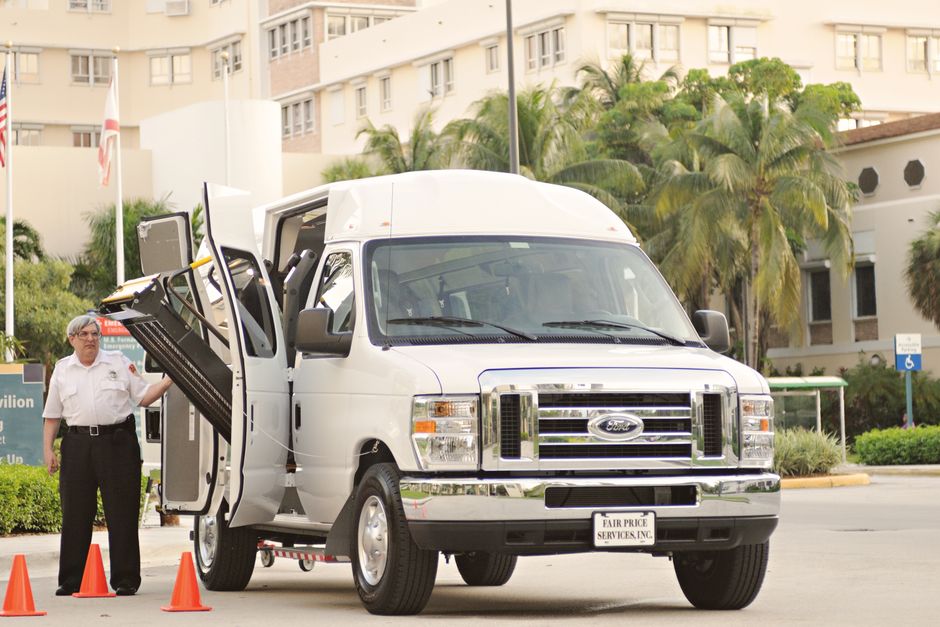
A wheelchair lift is a mechanical platform, usually located near the front or middle door of the bus, that lowers to ground level so a passenger in a wheelchair or scooter can roll on, then raises back up to the level of the bus floor. Lifts are standard equipment on many transit-style buses and on a growing number of motorcoaches built specifically for charter and tour use. They’re operated by the driver or an attendant and typically take just a minute or two to deploy.
Ramps
Some accessible vehicles, particularly smaller shuttle buses and minibuses, use a fold-out or slide-out ramp instead of a powered lift. Ramps tend to be simpler mechanically, which means less maintenance and fewer things that can break down, but they require a certain amount of clearance and a gentler slope, so they’re more common on lower-floor vehicles.
Low-Floor Design
Some newer buses are built with a “low-floor” chassis, meaning the floor of the bus sits closer to the ground than a traditional motorcoach. This design reduces or eliminates the need for a large lift altogether, since passengers can board more easily using a shorter ramp or even a slight step. Low-floor buses are becoming more common in transit fleets and are gradually making their way into the charter and shuttle market.
Securement Systems
Having a lift or ramp is only half the equation. Once a passenger using a wheelchair is on board, the bus needs a way to keep that wheelchair securely in place while the vehicle is moving. ADA-compliant vehicles include tie-down straps or locking systems, along with a lap and shoulder belt for the passenger, to keep everyone safe during transit. Reputable operators train their drivers on how to properly secure a wheelchair before departure, since improper securement can be a safety hazard.
Accessible Restrooms
This is a detail that catches a lot of groups off guard. Even on a motorcoach equipped with a wheelchair lift, the onboard restroom is not necessarily wheelchair accessible. Restroom doorways and interior space on most motorcoaches are quite narrow, and very few charter buses on the road today have a restroom that a wheelchair can actually enter. If restroom access during the trip is a concern for your group, it’s worth asking about this specifically, and you may find our article on whether charter buses have bathrooms helpful for setting expectations and planning rest stops accordingly.
Why Don’t All Charter Buses Have Lifts?
If the ADA requires equivalent service, you might wonder why every bus in a fleet isn’t simply built with a lift from the factory. There are a few practical reasons this hasn’t happened across the industry.
Cost and Retrofitting Challenges
A wheelchair lift is a complex mechanical and hydraulic system, and adding one to a large motorcoach isn’t as simple as bolting on a part. It requires structural modifications, additional wiring, and ongoing maintenance. For a large coach, this can add tens of thousands of dollars to the cost of the vehicle. Multiply that across an entire fleet, and it’s easy to see why many operators choose to maintain a smaller number of accessible vehicles rather than equip every bus.
Vehicle Age
Charter and tour companies often run a mixed fleet that includes both newer vehicles and older coaches that have been well maintained but were manufactured before lift requirements were as strict as they are today. Older vehicles that were purchased before certain phase-in dates may not have been required to include a lift when they were built, and retrofitting them later isn’t always cost-effective compared to simply designating newer vehicles as the accessible options.
Demand-Responsive Flexibility
Because charter service is demand-responsive rather than fixed-route, the law gives operators some flexibility in how they meet accessibility requirements. Rather than requiring every vehicle to be lift-equipped, the regulation allows companies to designate specific accessible vehicles within their fleet, or to arrange for an accessible vehicle from a partner company, as long as the end result is that a passenger with a disability isn’t denied equivalent service.
None of this means accessibility is optional. It means the responsibility falls on the operator to have a plan in place, and it falls on you, as the person booking, to communicate your needs early so that plan can be put into action.
How to Book an ADA-Accessible Charter Bus
If your group includes someone who uses a wheelchair, scooter, or other mobility device, here’s how to make sure the trip goes smoothly from the moment you request a quote to the moment everyone boards for the ride home.
1. Mention Accessibility Needs Upfront
Don’t wait until the week of the trip to bring up accessibility. When you first reach out for quotes, specify that you need a wheelchair-accessible vehicle, how many passengers will need the lift, and what type of mobility device is involved (manual wheelchair, power wheelchair, scooter, etc.). This detail affects which vehicles a company can offer and how much lead time they’ll need.
2. Ask Direct Questions
When you’re comparing charter companies, ask specific questions rather than a general “do you have accessible buses.” Useful questions include:
- Does this specific bus have a working wheelchair lift or ramp?
- What is the weight capacity of the lift?
- How many securement positions are available on board?
- Is the restroom on this bus wheelchair accessible, or only the boarding area?
- Has the lift been inspected and tested recently?
- Will the driver be trained to operate the lift and secure a wheelchair?
A trustworthy operator will have ready answers to these questions. Vague or evasive responses are a red flag.
3. Book Early
Accessible vehicles typically make up a smaller percentage of any company’s fleet, which means they get booked up faster, especially during busy seasons like spring field trip season, summer travel, or the holidays. Booking several weeks or even months ahead gives you the best chance of securing the specific vehicle you need. This is especially true for large-scale events like graduation ceremonies or university events, where dozens of buses might be reserved by different groups for the same weekend.
4. Confirm in Writing
Once a company confirms they can provide a lift-equipped bus, get that confirmation in writing, whether that’s an email, a note on your contract, or a confirmation through your booking platform. This protects you if there’s ever a mix-up on the day of the trip and gives you something concrete to reference if the vehicle that shows up doesn’t match what was promised.
5. Have a Backup Plan Conversation
Ask what happens if the designated accessible vehicle has a mechanical issue on the day of the trip. Reputable companies will have a contingency plan, whether that’s a backup vehicle in their own fleet or an agreement with a partner company. Knowing this in advance gives you peace of mind and one less thing to worry about on travel day.
What If a Charter Company Says They Don’t Have an Accessible Bus?
Occasionally, a group organizer will run into a charter company that claims they simply don’t have any wheelchair-accessible vehicles available. Here’s what you should know if that happens.
Under the ADA, a charter or tour bus operator cannot simply refuse service to a passenger with a disability. If the specific bus a company would normally offer isn’t accessible, the operator is required to make a reasonable effort to provide equivalent service. In practice, this can mean:
- Substituting a different vehicle in their own fleet that does have a lift.
- Subcontracting with another charter or transportation company that has an accessible vehicle available.
- Rearranging their fleet assignments so the accessible bus is used for your trip instead of a different one.
If a company flatly refuses to accommodate a passenger with a disability and makes no effort to find an alternative, that could be a violation of the ADA. You have the right to ask how they plan to accommodate the request, and if you feel a company isn’t taking the obligation seriously, it’s reasonable to look elsewhere. Reputable, established operators generally take these obligations seriously, both because it’s the law and because it’s good business, but it’s still worth vetting a company’s fleet and reputation before you commit, especially for a large or important trip. Our guide on whether charter buses are safe covers some of the broader vetting questions worth asking any operator, accessibility aside.
Can a Charter Company Charge Extra for an Accessible Bus?
No. This is one of the clearest parts of the regulation. A charter or tour operator cannot charge a passenger with a disability more than they would charge any other passenger for equivalent transportation. If a lift-equipped bus happens to cost more for the company to operate or maintain, that cost cannot be passed on to the passenger who needs the lift. Any surcharge tied specifically to providing a wheelchair lift or accessible seating would run afoul of federal law.
That said, general pricing factors like trip distance, bus size, and rental duration still apply the same way they would for any charter, accessible or not. If you’re budgeting for a trip and want a sense of typical pricing structures, it can help to look at guides based on group size, since the price of a rental is influenced far more by capacity and distance than by whether the bus includes a lift. Our planning guides for groups of 20 people, 40 people, and 60 people break down what to expect at different group sizes.
Special Considerations for Different Types of Group Trips
Accessibility needs don’t look the same for every trip. Here’s how the ADA lift question tends to come up across a few common types of group travel.
School Field Trips and Educational Outings
Schools have their own set of obligations under both the ADA and Section 504 of the Rehabilitation Act, which means transportation for students with disabilities needs to be planned with extra care. If your school is organizing a trip to a museum, science center, or other educational destination, and a student uses a wheelchair, that requirement should be communicated to the transportation coordinator as early as the trip is being planned, not the week before departure. Many of the same considerations apply whether you’re headed to a museum or a theme park.
Theme Park and Recreational Trips
Group trips to amusement parks or theme parks often involve long travel days, multiple stops, and larger groups, which makes early planning even more important. If your group includes riders with mobility devices, make sure the accessible bus request is part of your initial planning conversation, not an afterthought. Our theme park charter bus planning guide covers additional logistics worth thinking through for these kinds of trips.
Corporate Events and Conferences
Business groups sometimes overlook accessibility planning simply because it’s easy to assume everyone attending a conference or retreat will have similar mobility needs. But conferences, in particular, often draw a diverse group of attendees, including clients, vendors, and colleagues from different offices, some of whom may need accommodations. Building an accessibility question into your standard transportation request form for business conferences or company retreats is a simple way to avoid a last-minute scramble.
Ski Trips and Outdoor Group Travel
Cold-weather trips add another layer of complexity, since lifts and ramps need to function properly in snow and ice, and boarding areas can become slippery. If your group is headed out for a ski trip, ask specifically how the operator handles lift operation in winter conditions and whether the boarding area at your pickup location will be cleared and safe.
Summer Camps
Camps often transport large groups of children, sometimes including campers with disabilities, over the course of a season. If your camp works with the same charter company for recurring trips, it’s worth having a standing conversation about accessible vehicle availability at the start of the season rather than renegotiating it for every single outing. Our summer camp charter bus guide has more on setting up recurring transportation arrangements.
Questions to Ask Before You Sign a Contract
Before finalizing your booking, especially if accessibility is a factor, run through this checklist with the charter company:
- Will the exact bus assigned to our trip have a working wheelchair lift or ramp?
- How many wheelchair securement positions does that bus have, and does that match how many riders in our group will need one?
- What is the maximum weight capacity of the lift?
- Is there a backup vehicle available if the assigned bus has a mechanical issue?
- Will the driver be trained and comfortable operating the lift?
- Is there an extra fee involved in providing the accessible vehicle? (There shouldn’t be.)
- How much advance notice do you need to guarantee an accessible vehicle?
- Can we get written confirmation of the vehicle type and its accessibility features?
Getting clear answers to these questions before you sign anything will save you a lot of stress on the day of the trip. It also gives you a paper trail to point to if the vehicle that arrives doesn’t match what was promised.
What to Do If the Bus That Arrives Isn’t Accessible
Even with careful planning, mix-ups happen. If a bus shows up without the promised lift or ramp, here’s how to handle it in the moment:
- Contact the company immediately. Call your point of contact or the dispatch line right away, explain the situation, and ask what they can do to fix it on short notice.
- Document the issue. Take a photo of the vehicle and note the time. This isn’t about being adversarial, it’s about having a clear record if you need to follow up afterward.
- Ask about an immediate substitute. Many companies can dispatch a different vehicle from a nearby location if given the chance, particularly if you’re still at the pickup point rather than already on the road.
- Follow up afterward. If the issue wasn’t resolved satisfactorily, follow up with the company’s management after the trip. A pattern of failing to honor accessibility commitments is something worth raising directly with the company, and if necessary, it can be reported as a potential ADA compliance issue.
Most established charter companies take these situations seriously and will work quickly to correct the problem, both because they’re legally obligated to and because it’s the right thing to do for their customers. Vetting a company’s reputation and reading reviews ahead of time, the same way you would when researching the right bus for a large group, can help you avoid operators who are more likely to drop the ball on accessibility commitments.
Frequently Asked Questions
Do all charter buses have wheelchair lifts?
No. Not every charter bus in a company’s fleet is equipped with a wheelchair lift, but reputable companies are required to provide equivalent accessible transportation, which usually means having at least one lift-equipped vehicle available or arranging one through a partner company.
How much advance notice do I need to give for an accessible charter bus?
Charter and tour operators are generally allowed to require up to 48 hours notice to arrange an accessible vehicle, but it’s best practice to mention accessibility needs at the very beginning of the booking process, ideally weeks in advance for larger trips.
Can a charter bus company charge more for a wheelchair-accessible vehicle?
No. Under the ADA, operators cannot charge passengers with disabilities extra for accessible transportation. The price should be the same as it would be for any other passenger taking the same trip.
Are charter bus restrooms wheelchair accessible?
Usually not. Even buses equipped with a wheelchair lift for boarding often have very narrow onboard restrooms that aren’t accessible to wheelchair users. If this is a concern, ask the operator directly and plan rest stops accordingly.
What should I do if a charter company says they have no accessible buses at all?
Ask how they plan to provide equivalent service, since the ADA requires operators to make reasonable arrangements, such as substituting a vehicle from their own fleet or subcontracting with another provider. If a company refuses to make any accommodation, consider looking for a different operator.
Final Thoughts
The short answer to “do charter buses have ADA lifts” is that some do and some don’t, but every reputable charter company is required to provide accessible transportation in one form or another when a passenger needs it. The key to a smooth experience isn’t finding a company that happens to have a lift on every single bus, it’s finding a company that takes its obligations seriously, communicates clearly, and gives you enough lead time to get the right vehicle in place.
If your group includes riders who use wheelchairs, scooters, or other mobility devices, bring that up the moment you start requesting quotes. Ask direct questions about the specific vehicle, get commitments in writing, and book as early as you can, especially during busy travel seasons. Do that, and accessibility becomes just one more detail you’ve planned for, rather than a source of stress on the day of your trip.