
Charter Bus vs Rental Vans: Which Is Right for Your Group Trip?

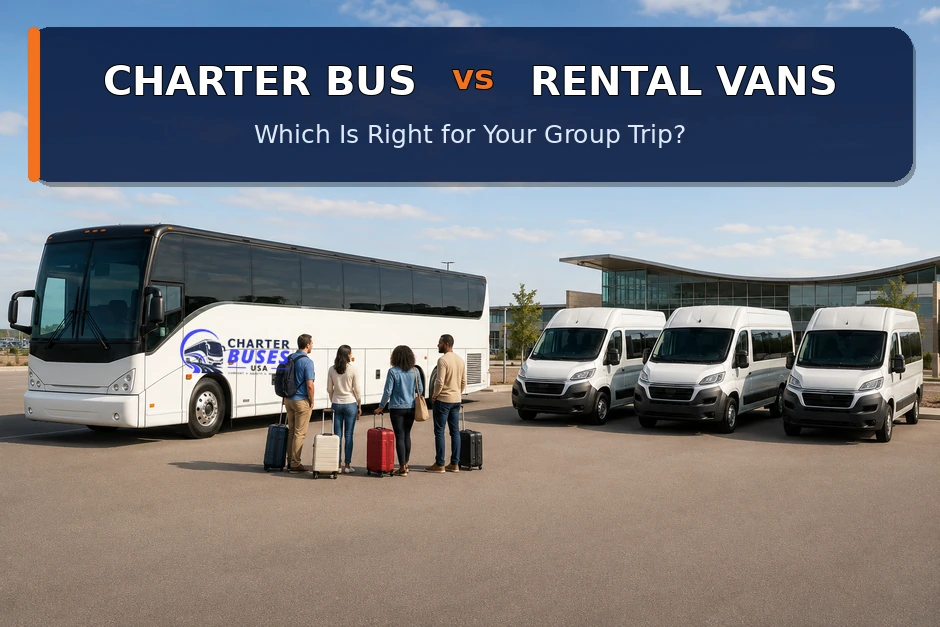
Planning group transportation always comes down to a handful of practical questions: how many people are traveling, how far are they going, and how much are you willing to spend? For many event planners, school administrators, and corporate travel coordinators, the decision narrows to two main options: a charter bus or a fleet of rental vans. The charter bus vs rental vans debate isn’t just about size, it touches on cost, safety, driver logistics, comfort, and the overall experience your group will have on the road.
In this guide, we’ll break down every major factor you need to weigh before booking transportation for your next trip. By the end, you’ll know exactly which option fits your group size, budget, and travel goals, whether you’re moving a sports team across the state, shuttling employees to a retreat, or organizing a multi-day tour for dozens of travelers.
Charter Bus vs Rental Vans: A Quick Comparison
Before diving into the details, here’s a snapshot of how these two options stack up against each other:
- Capacity: Charter buses typically hold 20 to 56+ passengers; rental vans usually seat 8 to 15 people each.
- Driver requirements: Charter buses come with a professional, licensed driver included; rental vans require one of your own people to drive, often without commercial training.
- Cost per person: Charter buses are often cheaper per passenger for groups over 15 people; vans can be cheaper for very small groups.
- Safety: Charter buses are subject to strict federal safety regulations and professional maintenance schedules; rental vans rely on the driving skill of whoever is behind the wheel.
- Comfort: Charter buses offer reclining seats, climate control, restrooms, and entertainment systems; vans offer more basic seating with limited amenities.
- Logistics: One charter bus keeps everyone together; multiple vans mean coordinating separate vehicles, drivers, and routes.
Now let’s look at each of these points in more depth so you can make an informed decision for your specific trip.
What Exactly Is a Charter Bus?
A charter bus is a large motorcoach rented out for private group use, complete with a professional driver. Unlike public transit buses, charter buses are booked exclusively for one group at a time, meaning there are no strangers on board and no fixed stops other than the ones you request.
Charter buses generally come in a few sizes:
- Minibuses: Seat roughly 20 to 30 passengers, ideal for mid-sized groups.
- Standard motorcoaches: Seat 40 to 56 passengers, the most common option for large events.
- Double-decker or executive coaches: Offer premium seating, extra storage, and sometimes onboard restrooms and Wi-Fi.
Charter companies handle everything from vehicle maintenance to driver scheduling, and the driver stays with the group for the entire trip, including waiting during stops. This
For related reading, see our guide on Charter Bus Rental for Theme Parks: The Complete Planning Guide.
consistency helps keep large groups organized and reduces the logistical headaches that come with multi-stop itineraries or trips with tight schedules. Whether you’re heading to a theme park, a stadium, or a multi-day conference, having one driver who knows the full itinerary means fewer opportunities for miscommunication or delay.
What Are Rental Vans?
Rental vans are exactly what they sound like: passenger vans rented from a car rental company or dealership, typically driven by a member of your own group rather than a professional chauffeur. They’re a popular choice for smaller groups who want more control over their schedule and don’t mind handling the driving themselves.
Rental vans generally fall into a few categories:
- Minivans: Seat 6 to 8 passengers, best for very small groups or families.
- 12-passenger vans: A common choice for youth sports teams, small church groups, or college clubs.
- 15-passenger vans: The largest standard rental van size, though these have drawn safety scrutiny over the years due to rollover risks when fully loaded.
- Sprinter or cargo-style passenger vans: Slightly more spacious, often with higher rooflines for standing room and extra luggage space.
Unlike charter buses, rental vans usually require someone in your group to hold a valid driver’s license and be comfortable driving an unfamiliar, larger vehicle, sometimes for hours at a stretch. Some rental companies offer chauffeured van services, but this is less common and often more expensive than simply renting a self-drive van.
Charter Bus vs Rental Van: A Head-to-Head Comparison
To really understand which option fits your trip, it helps to break the comparison down into the categories that matter most to group travel planners: cost, capacity, safety, comfort, and logistics. Let’s go through each one.
Cost Comparison
On the surface, rental vans often look cheaper. A single 12-passenger van might rent for $100 to $200 per day, while a charter bus for 40+ passengers could run $1,000 to $2,000 or more for a full day, depending on distance and duration. But that surface-level comparison doesn’t tell the whole story.
When you calculate the true cost per passenger, and factor in the hidden expenses that come with vans, charter buses often end up being more cost-effective for medium to large groups. Consider the following hidden van costs:
- Fuel: Multiple vans mean multiple fuel tanks to fill, and large vans are not fuel-efficient.
- Parking: Finding parking for two, three, or four vans at a busy venue is far harder than parking one bus.
- Tolls: Every van pays its own toll, multiplying costs on long routes.
- Insurance: Rental companies often charge extra for supplemental liability coverage, and this cost multiplies with each additional van.
- Driver time: If a group member is driving, that person isn’t relaxing, socializing, or enjoying the trip, and their time has real value even if it’s not a line item on an invoice.
Charter buses, by contrast, are priced as a single flat rate that typically includes the driver, fuel, and standard insurance coverage. There are no surprise charges for extra mileage between vehicles or the risk of one van needing repairs mid-trip while others wait.
Passenger Capacity
This is often the deciding factor. If your group has 10 people or fewer, a single van might be all you need, and a charter bus would be overkill. But once your group grows past 15 or 20 people, you’re looking at needing two or three vans just to fit everyone, which introduces a whole new set of coordination challenges.
Charter buses scale much more efficiently. A standard motorcoach can comfortably seat 40 to 56 passengers in a single vehicle, meaning a group of 45 people needs just one bus and one driver, compared to four separate 12-passenger vans and four separate drivers. For large groups such as sports teams, school trips, or corporate outings, this is a massive logistical advantage. Our guide on charter bus rental for 40 people breaks down exactly how sizing works for mid-to-large groups.
Driver Requirements and Safety
Charter bus drivers are professional, licensed commercial drivers who undergo background checks, regular drug testing, and strict hours-of-service regulations designed to prevent fatigue-related accidents. They’re also trained specifically to operate large vehicles safely in a variety of traffic and weather conditions.
Rental van drivers, on the other hand, are usually just regular members of your group, sometimes with little to no experience driving a large 12- or 15-passenger van. This matters more than people often realize. Fully loaded 15-passenger vans have a documented history of increased rollover risk, especially when driven by inexperienced drivers or on unfamiliar highways. The National Highway Traffic Safety Administration has published specific safety warnings about these vehicles, and many organizations, including some universities and school districts, have banned their use entirely for group travel because of the risk.
There’s also the fatigue factor. If your group’s driver has to navigate traffic, keep an eye on GPS, manage stops, and stay alert for hours, that’s a lot of pressure and risk, especially after a long day of activities. Charter bus drivers are rested, focused, and solely responsible for driving, which frees everyone else in your group to relax, sleep, or socialize.
Comfort and Amenities
Modern charter buses are built for long-distance comfort. Reclining seats, individual reading lights, climate control, onboard restrooms, and in many cases free Wi-Fi and power outlets make the ride itself part of the experience rather than something to endure. Some premium coaches even include entertainment systems, extra legroom, and overhead storage for luggage and equipment.
Rental vans are far more basic. Bench seating is typically upright and less cushioned, there’s no onboard restroom, and climate control is limited to whatever the van’s factory air conditioning can handle for the number of passengers aboard. For short trips of an hour or less, this may not matter much. But for longer trips, especially those lasting several hours or spanning multiple days, the comfort gap becomes significant, and it can affect group morale, especially with younger travelers, older adults, or anyone with mobility considerations.
Logistics and Coordination
This is where charter buses truly shine for larger groups. With a single bus, your group stays together from pickup to drop-off. There’s no risk of vans getting separated in traffic, no confusion about which vehicle has the cooler with everyone’s lunches, and no need for a group chat dedicated to tracking multiple drivers’ locations.
Multiple vans introduce coordination challenges that grow exponentially with each additional vehicle. You need to plan:
- Meeting points if vehicles get separated
- Communication methods between drivers (walkie-talkies, group texts, or phone trees)
- Consistent fuel stops so no van runs low while others wait
- Backup plans if one van experiences mechanical issues
- Fair distribution of luggage, equipment, and passengers across vehicles
For event organizers managing school trips, church groups, or corporate outings, this added complexity can turn what should be a simple transportation decision into a full-time logistics project. A single charter bus eliminates nearly all of these headaches.
When a Charter Bus Is the Better Choice
Charter buses tend to make the most sense in the following situations:
- Large groups: Once your headcount climbs past 20 or 25 people, a charter bus becomes more efficient than coordinating multiple vans.
- Long-distance travel: For trips lasting more than a couple of hours, the comfort and amenities of a motorcoach make a real difference in group energy and satisfaction.
- Safety-sensitive groups: Schools, youth organizations, and senior groups benefit enormously from professional drivers and built-in safety standards. Many senior group trips specifically choose charter buses for this reason.
- Events requiring everyone to arrive together: Weddings, graduations, and formal events often need the whole group to arrive and depart as a unit, which a single bus guarantees.
- Sports teams and traveling squads: Athletes need to arrive rested and together, with room for equipment. Check out our guide to charter bus rental for sports teams for more on this.
- Corporate retreats and conferences: Companies that want to project professionalism and keep employees together often prefer chartering a bus over a fleet of rental vans. Our company retreat planning guide covers this in more detail.
When Rental Vans Make More Sense
Despite the advantages of charter buses for larger groups, rental vans aren’t obsolete. They still make sense in a number of scenarios:
- Very small groups: If your group has 10 people or fewer, a single van is often more practical and cost-effective than chartering a bus.
- Short, local trips: For quick trips under an hour, the comfort gap between a van and a bus matters less.
- Flexible, multi-stop itineraries: If your group needs to split up frequently or make several unscheduled stops throughout the day, a van (or a couple of vans) offers more flexibility than a bus that has to accommodate a large group’s movements as a whole.
- Tight, last-minute budgets: If cost is the single most important factor and your group is small enough, a van rental might come in cheaper upfront, even accounting for fuel and driver time.
- Off-the-beaten-path destinations: Vans can navigate narrow roads, small parking lots, and rural areas that a large motorcoach might struggle to access.
Cost Breakdown: Real Numbers to Consider
To put this comparison in more concrete terms, here’s a general breakdown of how costs tend to stack up. Keep in mind that exact pricing varies by region, season, and rental company, but this gives you a realistic frame of reference.
- 12-passenger van rental: Roughly $100 to $180 per day, plus fuel (often $50 to $100 for a full day of driving) and any insurance add-ons.
- 15-passenger van rental: Roughly $150 to $250 per day, plus similar fuel and insurance costs.
- Minibus (20-30 passengers) with driver: Roughly $800 to $1,200 for a full day, all-inclusive.
- Standard motorcoach (40-56 passengers) with driver: Roughly $1,200 to $2,200 for a full day, all-inclusive, depending on distance and trip length.
When you divide these costs by the number of passengers, the picture often shifts. A group of 40 people using three or four vans might collectively spend $600 to $900 on van rentals alone, before adding fuel, insurance, tolls, and parking for multiple vehicles. That same group in one motorcoach might spend $1,200 to $2,000 total, which often works out to a very similar or even lower per-person cost once every hidden van expense is tallied up, all while gaining the comfort and safety benefits of a single, professionally driven vehicle.
Group Size Scenarios: What Actually Works Best
Every group is different, but here’s a general framework based on typical group sizes.
Small Groups (Under 15 People)
For groups this size, a single rental van is usually the most practical and affordable option, assuming someone in the group is comfortable driving and the trip isn’t excessively long. If your group falls into this range but you still want the comfort of a professional driver, a smaller charter option like a minibus might be worth pricing out. Our guide on charter bus rental for 20 people is a useful resource if your group is on the smaller end of the mid-size range.
Medium Groups (20 to 35 People)
This is the range where the decision gets more nuanced. Two to three vans could technically fit a group this size, but the coordination burden starts to outweigh the savings. Many organizers in this range find that a minibus or smaller motorcoach offers a better balance of cost, comfort, and simplicity.
Large Groups (40+ People)
Once you’re planning for 40 or more travelers, a standard motorcoach is almost always the more sensible choice. Coordinating four or more vans for a group this size introduces significant safety, communication, and cost inefficiencies. A single charter bus keeps everyone together, simplifies check-in and departure times, and dramatically reduces the administrative burden on whoever is organizing the trip. If you’re managing a group in the 60-person range, our charter bus rental for 60 people guide walks through exactly what to expect.
Special Event Considerations
Beyond group size, the type of event you’re planning can also influence which option makes more sense.
School and Youth Trips
Given the well-documented safety concerns around 15-passenger vans, many schools and youth organizations have moved away from van rentals entirely in favor of chartered transportation with licensed, insured drivers. This is especially true for field trips, summer camp transportation, and graduation events.
Weddings and Formal Events
Guests attending weddings often need to arrive looking presentable and on time, without the stress of navigating unfamiliar roads or parking. A charter bus or shuttle solves this problem elegantly, especially for guests traveling between a hotel block and a venue.
Corporate Events and Conferences
Professional appearances matter, and arriving in a fleet of rental vans can look disorganized compared to a branded or simply well-maintained charter bus. Companies hosting business conferences often prefer the streamlined, professional impression a charter bus provides.
Festivals and Concerts
Large crowds, limited parking, and long waits are hallmarks of festival and concert transportation. A charter bus allows your entire group to be dropped off close to the venue and picked up afterward without anyone needing to worry about driving home after a long day.
Environmental Impact
If sustainability is a consideration for your group or organization, it’s worth noting that a single charter bus produces significantly less emissions per passenger than multiple vans covering the same distance. Motorcoaches are among the most fuel-efficient forms of group transportation available, often outperforming even public transit on a per-passenger-mile basis. For groups looking to minimize their environmental footprint, consolidating travel into one larger vehicle instead of several smaller ones is a simple but meaningful choice.
Decision Checklist: Charter Bus or Rental Van?
If you’re still weighing your options, ask yourself the following questions:
- How many people are traveling? (Under 15: van likely works. Over 20: bus is usually more efficient.)
- How long is the trip? (Longer trips favor the comfort of a bus.)
- Does anyone in the group need to drive, or would everyone prefer to relax?
- Is safety a top priority, especially for minors, seniors, or large groups?
- Do you need everyone to arrive and depart together, or is flexibility more important?
- What’s your total budget, including fuel, insurance, tolls, and parking, not just the base rental price?
- Will you need amenities like restrooms, Wi-Fi, or climate control for a long ride?
Answering these questions honestly will usually point you toward the right choice fairly quickly. There’s no single correct answer for every trip, but there is usually a clear best answer for your specific trip.
Frequently Asked Questions
Is it cheaper to rent a charter bus or multiple vans?
It depends on group size. For groups under 15 people, vans are often cheaper upfront. For groups of 20 or more, a charter bus is frequently more cost-effective once you factor in fuel, insurance, tolls, and parking for multiple vehicles.
Do I need a special license to drive a rental van?
In most cases, a standard driver’s license is sufficient to rent and drive a 12- or 15-passenger van, though some rental companies have minimum age requirements or additional insurance requirements for larger vans. Charter buses, by contrast, always come with a professional driver, so no special license is needed from your group.
Are 15-passenger vans safe for group travel?
Fully loaded 15-passenger vans have a higher documented rollover risk compared to smaller vehicles, particularly when driven by inexperienced drivers. Many schools, universities, and organizations have restricted or banned their use for this reason. Charter buses, driven by trained commercial drivers, are generally considered a safer option for group travel.
Can a charter bus accommodate a small group?
Yes, charter companies offer smaller vehicles like minibuses that seat 20 to 30 passengers, which can be a good middle ground for groups that are too large for a single van but not quite large enough for a full-size motorcoach.
How far in advance should I book a charter bus versus a rental van?
Charter buses typically require more advance notice, ideally two to four weeks or more for popular travel dates, since availability can be limited. Rental vans can often be booked more last-minute, sometimes within a day or two, though popular models may still sell out during peak travel seasons.
Final Thoughts
Choosing between a charter bus and rental vans really comes down to your group’s size, budget, and priorities. Smaller groups traveling short distances on a tight budget will likely find rental vans perfectly adequate. But as group size grows, trip length increases, or safety and comfort become higher priorities, a charter bus quickly becomes the more practical, and often more affordable, choice.
Before booking either option, take the time to calculate your true total cost, factor in the value of everyone’s comfort and safety, and think honestly about how much coordination your group can realistically handle. Whichever option you choose, planning ahead and booking early will always put you in the best position for a smooth, enjoyable group trip.