
Charter Bus vs Carpooling: Which Option Is Right for Your Group?

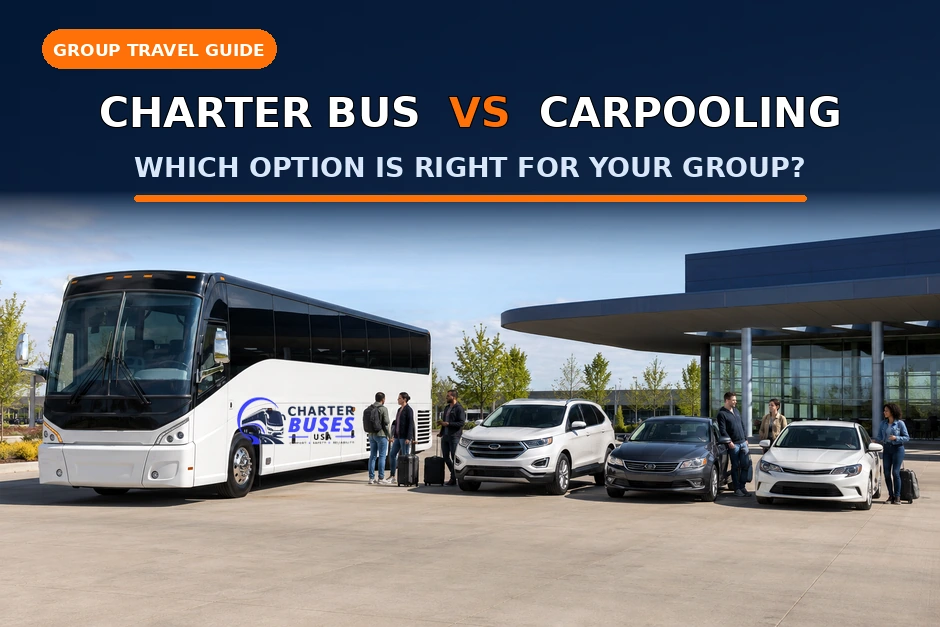
Planning group transportation always comes down to a handful of practical questions: How many people are going? How far are you traveling? What’s the budget? And, honestly, how much stress are you willing to deal with on travel day? When groups start weighing their options, the debate often narrows down to two choices: charter bus vs carpooling. Both get people from point A to point B, but the similarities pretty much end there.
In this guide, we’ll break down the real differences between renting a charter bus and organizing a carpool, covering cost, safety, comfort, logistics, and environmental impact. By the end, you’ll have a clear framework for deciding which option actually makes sense for your specific trip, whether that’s a corporate outing, a school field trip, a wedding, or a weekend getaway with friends.
Charter Bus vs Carpooling: The Quick Overview
Before diving into the details, here’s the short version. Carpooling works well for small, informal groups traveling short distances with flexible schedules. Charter bus rental works better for larger groups, longer trips, tighter schedules, or situations where safety, comfort, and coordination matter more than saving a few dollars per person.
Neither option is universally
For related reading, see our guide on Charter Bus Rental for Theme Parks: The Complete Planning Guide.
the right answer for every trip, and the smartest move is to actually run the comparison before you book anything. Let’s dig into the specifics.
Cost Comparison: Charter Bus vs Carpooling
Cost is usually the first factor groups look at, and it’s also the one that gets misunderstood the most. On the surface, carpooling looks like the obvious winner because there’s no rental fee involved. But once you factor in gas, wear and tear, parking, tolls, and the hidden costs of inefficiency, the math isn’t always as simple as it seems.
The Real Cost of Carpooling
When a group carpools, the total cost gets split across multiple personal vehicles rather than one shared expense. That means:
- Fuel costs multiply. Instead of one vehicle burning fuel efficiently for the whole group, you might have three, four, or five separate cars all making the same trip.
- Parking fees add up fast. A single charter bus might pay one parking fee at a venue, while five cars pay five separate fees, sometimes at a higher per-vehicle rate.
- Wear and tear isn’t free. Long drives put mileage on personal vehicles, which translates into maintenance costs down the road, even if nobody notices it immediately.
- Tolls get duplicated. Every vehicle in the caravan pays its own toll, which can turn a minor expense into a real budget line item over a long trip.
For a short, local trip with two or three cars, these costs are minor. But for a large group heading several hours away, the numbers start to look very different.
The Real Cost of Charter Bus Rental
Charter bus rental is priced as a flat rate (or hourly rate for shorter trips), which means the total cost is predictable and can be divided evenly across every rider. For groups of 20, 30, or more, this often ends up being cheaper per person than carpooling once fuel, parking, and vehicle wear are factored in.
Charter bus pricing typically depends on:
- Distance traveled and total trip duration
- Bus size and amenities (WiFi, restroom, reclining seats, etc.)
- Time of year and demand (holidays and peak travel seasons cost more)
- Whether the trip requires an overnight stay for the driver
If you’re trying to estimate cost, it helps to look at real numbers based on group size. Our guides on charter bus rental for 20 people and charter bus rental for 60 people break down typical pricing ranges so you can compare against what carpooling would actually cost your group.
The bottom line: carpooling tends to win on cost for very small, informal groups traveling short distances. Charter bus rental tends to win on cost-per-person for larger groups or longer trips, especially once you account for the hidden expenses of driving multiple personal vehicles.
Safety Considerations
Safety is arguably the most important factor in this comparison, and it’s one that often gets overlooked in the excitement of trip planning.
Carpooling Safety Risks
Carpooling relies entirely on personal vehicles and individual drivers, which introduces a level of unpredictability that professional transportation simply doesn’t have. Consider the risks:
- Driver fatigue. Unlike professional bus drivers, carpool drivers are rarely trained for long-distance driving and may not recognize the signs of fatigue until it’s too late.
- Inconsistent vehicle maintenance. Not every personal vehicle is properly maintained. Worn brakes, bald tires, or outdated safety features can turn a routine trip into a dangerous one.
- Distracted driving. More passengers in a personal car often means more distractions, more conversation, more requests for the driver’s attention.
- Caravan separation. When multiple cars try to travel together, it’s incredibly common for vehicles to get separated at traffic lights, on highways, or during unexpected stops, leading to confusion and even accidents as drivers try to catch up.
- No professional licensing requirements. Anyone with a valid driver’s license can drive a carpool vehicle, regardless of their experience with long trips, night driving, or heavy traffic.
Charter Bus Safety Advantages
Charter bus companies operate under a completely different set of standards. Professional drivers are commercially licensed, undergo regular training, and are subject to strict hours-of-service regulations designed to prevent fatigue-related accidents. Buses themselves are inspected regularly and must meet federal safety standards enforced by the Federal Motor Carrier Safety Administration.
Additional safety benefits include:
- One vehicle to track instead of several, which eliminates the risk of caravan separation
- Professional drivers trained specifically for group transportation, long routes, and adverse weather
- Regular vehicle inspections and maintenance schedules required by law
- Seatbelts, emergency exits, and safety equipment built into every seat
- No risk of an inexperienced or distracted friend behind the wheel
For groups traveling with children, elderly passengers, or anyone with mobility concerns, this safety gap becomes even more significant. A single professionally driven bus is simply a more controlled environment than a scattered fleet of personal vehicles.
Comfort and Convenience
Beyond cost and safety, comfort plays a huge role in how a trip actually feels once you’re on the road.
Carpooling Comfort Limitations
Personal vehicles weren’t designed with long-distance group comfort in mind. Depending on the car, passengers might be squeezed into a back seat for hours, dealing with limited legroom, no climate control preferences, and zero privacy. Bathroom breaks require pulling off the road and hoping everyone in the caravan stops at the same place. And if someone gets carsick, feels claustrophobic, or just needs to stretch, there’s no good solution until the next rest stop.
Charter Bus Comfort Advantages
Modern charter buses are built specifically for long trips and large groups. Depending on the bus and amenities selected, passengers can enjoy:
- Reclining seats with more legroom than a typical car
- Onboard restrooms, eliminating the need for constant stops
- Climate control throughout the cabin
- WiFi and charging outlets for staying connected or entertained
- Overhead storage and luggage bays for group gear
- Room to move around, chat with other passengers, or simply relax
This matters most on longer trips. A 30-minute carpool to a nearby venue is one thing, but a four-hour drive to a tournament, conference, or family reunion is a completely different experience in a car versus a bus. If your trip involves an overnight stay, our overnight charter bus trips guide covers what to expect when comfort needs to last well beyond a single afternoon.
Logistics and Coordination
This is where carpooling often falls apart, even for groups with the best intentions.
The Coordination Headache of Carpooling
Organizing a carpool sounds simple until you actually try to do it for more than a handful of people. Suddenly you’re dealing with:
- Assigning drivers and passengers, then reassigning them when someone cancels last minute
- Coordinating departure times across multiple households or offices
- Deciding who pays for gas, and how
- Making sure everyone knows the route, especially if cell service drops out
- Managing what happens if one car breaks down or gets a flat tire
- Figuring out parking for multiple vehicles at the destination
- Dealing with drivers who need to leave early or arrive separately
Every additional car adds another layer of coordination. What starts as a simple plan can quickly turn into a group chat full of last-minute changes, confusion about meeting points, and the inevitable person who gets lost or shows up late.
The Simplicity of Charter Bus Logistics
With a charter bus, most of that coordination disappears. Everyone meets at one pickup location, boards one vehicle, and arrives together. There’s no need to track multiple cars, worry about who’s driving, or manage separate arrival times. If your itinerary includes several destinations, many charter bus rentals can even accommodate that. Our guide on whether a charter bus can make multiple stops explains how flexible scheduling works for groups with more complex travel plans.
Charter bus companies also handle route planning, parking arrangements, and driver logistics as part of the service, which takes a huge amount of pressure off whoever is organizing the trip. If you want to understand what a smooth pickup and drop-off actually looks like, it’s worth reviewing our charter bus pickup and drop-off guide before your trip.
Environmental Impact
Sustainability is becoming a bigger factor in group travel decisions, especially for schools, universities, and companies with environmental goals.
It might seem like carpooling is automatically the greener choice since it reduces the number of vehicles compared to everyone driving separately. But when you compare a full carpool (say, four or five cars) to a single charter bus carrying the same number of people, the bus usually wins on emissions per passenger. Buses are designed to move large groups efficiently, and modern charter buses often meet strict emissions standards. One bus replacing five or six cars on the road means less fuel burned overall, less traffic congestion, and a smaller collective carbon footprint for the trip.
For groups that care about sustainability messaging, whether it’s a university event, a corporate retreat, or a school trip, choosing a charter bus can actually be the more environmentally responsible choice, not just the more convenient one.
Scheduling and Time Efficiency
Time is money, and it’s also sanity. Here’s how the two options stack up when it comes to actually sticking to a schedule.
Carpooling and Schedule Drift
Carpools are notoriously vulnerable to schedule drift. One person runs late, another stops for gas, someone needs a bathroom break at a different time than the rest of the group, and suddenly a trip that should have taken three hours takes four and a half. Multiply that by several vehicles and the chances of everyone arriving on time, together, drop significantly.
Charter Bus and Reliable Timing
A charter bus runs on a single schedule. Once everyone boards, the departure time is set, and the professional driver manages the route, rest stops, and arrival time as a single unit. This is especially valuable for time-sensitive events like graduation ceremonies, conferences, or flights, where being even 20 minutes late can cause real problems. If your event has a hard start time, our charter bus rental for graduation ceremonies guide is a good example of how tight scheduling gets managed for high-stakes events.
When Carpooling Is the Better Choice
Despite everything above, carpooling absolutely has its place. It tends to make the most sense when:
- The group is small. Two to six people can usually fit comfortably in one or two personal vehicles without much hassle.
- The distance is short. A 20-minute drive across town doesn’t justify the cost or planning involved in a charter bus rental.
- Schedules are flexible. If nobody needs to arrive at an exact time, minor delays from carpooling aren’t a big deal.
- The trip is informal. A casual outing with friends or coworkers doesn’t need the structure that a charter bus provides.
- Budget is extremely tight. For very small groups, splitting gas money is often cheaper than any rental option.
Examples where carpooling works well include a small group heading to a nearby restaurant, a few coworkers commuting to an offsite meeting across town, or a handful of friends driving to a local event together.
When a Charter Bus Is the Better Choice
On the other hand, a charter bus becomes the clearly stronger option when:
- The group is large. Once you’re coordinating more than a few vehicles, the logistics of carpooling become genuinely difficult to manage.
- The trip is long-distance. Multi-hour drives are safer, more comfortable, and often more cost-effective on a bus than in several personal cars.
- Timing matters. Weddings, conferences, graduations, and flights all have fixed schedules that a single, professionally driven vehicle can meet more reliably.
- Safety is a priority. Groups traveling with children, elderly passengers, or anyone with mobility needs benefit from the controlled environment of a charter bus.
- Comfort matters for the trip’s purpose. If people need to arrive rested, alert, or ready to perform (think sports teams or performers), a bus provides a far better environment than a cramped car.
- You want to avoid liability. Organizations often prefer charter buses to avoid the liability of employees or volunteers driving personal vehicles for company or school business.
Long-distance trips in particular tend to tip the scale heavily toward charter bus rental. If your trip falls into this category, our long-distance charter bus travel tips guide covers everything from rest stop planning to overnight logistics.
Scenario-by-Scenario Breakdown
Sometimes it helps to see the decision applied to real situations. Here’s how the charter bus vs carpooling debate typically plays out across common group travel scenarios.
School Field Trips
Schools almost always choose charter buses over carpooling, and for good reason. Liability concerns alone make personal vehicle caravans a poor choice for transporting students. Add in the need for consistent supervision, fixed schedules, and safety standards, and a charter bus becomes the obvious pick, even for smaller class sizes.
Corporate Events and Retreats
For company outings, a charter bus keeps everyone together, reduces liability, and often turns travel time into productive time with WiFi onboard. Carpooling might work for a small team of five or six heading to a nearby venue, but for larger departments or multi-day retreats, a bus is far more practical. Our charter bus rental for company retreats guide walks through how businesses typically plan these trips.
Weddings
Weddings often involve guests unfamiliar with the area, multiple venues (ceremony, photos, reception), and a strict timeline. Carpooling introduces the risk of guests getting lost or arriving late, while a charter bus keeps everyone on schedule and eliminates parking headaches at each location.
Sports Teams
Athletes need to arrive rested and focused, not cramped into the back seat of a teammate’s car after a two-hour drive. Charter buses also simplify equipment transport, which is nearly impossible to coordinate across multiple personal vehicles.
Weekend Getaways With Friends
This is one of the more genuinely split scenarios. For a small group of four to six close friends heading somewhere within an hour or two, carpooling can be a fun, budget-friendly option. But for larger friend groups or trips involving several hours of driving, a charter bus removes the stress of navigation, fuel costs, and driver fatigue, letting everyone actually relax and enjoy the trip together.
University Events
Campus organizations often deal with large student groups heading to conferences, competitions, or off-campus events. Carpooling with student drivers raises obvious liability and safety concerns, which is why most universities lean toward charter bus rental. Our charter bus rental for university events guide breaks down how schools typically handle this kind of group travel.
Making the Final Decision: Questions to Ask Your Group
If you’re still on the fence, run through these questions before booking anything:
- How many people are actually traveling? Under six people traveling a short distance often favors carpooling. Beyond that, a bus usually makes more sense.
- How far is the trip? Short local trips favor carpooling. Anything over an hour or two starts favoring a charter bus.
- Is there a fixed arrival time? If being late isn’t an option, a charter bus offers far more reliability.
- Who is responsible if something goes wrong? Organizations and event planners should think carefully about liability before relying on personal vehicles.
- What’s the total cost per person, realistically? Factor in gas, parking, tolls, and vehicle wear before assuming carpooling is cheaper.
- Does the group need to arrive together? If unity matters, whether for a team, a class, or a wedding party, a single bus keeps everyone on the same page.
Once you’ve answered these questions honestly, the right choice usually becomes pretty clear. And if a charter bus ends up being the better fit, it’s worth reviewing what happens before you even step on board. Our charter bus travel checklist before departure covers exactly what to prepare so your trip starts off smoothly.
Frequently Asked Questions
Is carpooling always cheaper than a charter bus?
Not necessarily. For small groups traveling short distances, carpooling is often cheaper. But for larger groups or longer trips, the combined cost of fuel, parking, tolls, and vehicle wear across multiple cars can end up higher than the flat rate of a charter bus split among riders.
How many people need to be traveling before a charter bus makes sense?
There’s no exact cutoff, but many groups find that once they’re coordinating more than three or four vehicles, a charter bus becomes more practical, cost-effective, and easier to manage than carpooling.
Is a charter bus safer than carpooling?
Generally, yes. Charter buses are driven by professionally licensed drivers, undergo regular safety inspections, and are regulated by federal transportation standards. Carpooling relies on personal vehicles and drivers who may not have the same training, experience, or vehicle maintenance standards.
Can a charter bus accommodate multiple pickup locations like a carpool would?
Yes, many charter bus rentals can be arranged with multiple pickup points or stops along the route, offering some of the flexibility people associate with carpooling while still keeping the group together for the majority of the trip.
What’s the best option for a mid-sized group, like 15 to 25 people?
At this size, carpooling usually becomes impractical to coordinate, requiring four or more vehicles. A charter bus, or a smaller minibus depending on the group, typically offers better cost efficiency, safety, and convenience. Our guide on the best charter bus for small groups can help you find the right fit for this size range.
Final Thoughts
There’s no single right answer in the charter bus vs carpooling debate, but there is a right answer for your specific trip. Small, informal groups traveling short distances with flexible timing will often do just fine carpooling, especially when budgets are tight and the stakes are low. But once you’re dealing with larger groups, longer distances, fixed schedules, or any real concern about safety and liability, a charter bus consistently comes out ahead on nearly every measure that matters: cost per person, comfort, coordination, and peace of mind.
Before you default to whatever your group has always done, take a few minutes to actually run the comparison for your trip. Count the vehicles a carpool would require, estimate the real cost including gas and parking, and think honestly about how much coordination headache you’re willing to take on. In many cases, you’ll find that a charter bus doesn’t just make the trip easier, it makes it better for everyone involved.